HA…She Didn’t Come Alone: The Silent Man Beside Amber Said Everything Without a Word
Dramatized skit recap based on the Kountry Wayne skit “When Amber goes at Wayne like never before!” No dialogue below is presented as exact quotes from the video.
The most important person in this video never says a word. He has no name in the title, no line in the confrontation, no moment of his own — and the entire physics of the scene bends around him anyway. He is the bearded man in the black turtleneck and glasses who walks across the plaza at Amber’s side in the opening frames, whose arm rests around her shoulder as they arrive, and who then takes up his position — arms crossed, expression sealed, present the way a monument is present — while the wife of Anthony delivers four minutes of argument at Wayne, the saga’s great explainer, in broad daylight. “When Amber goes at Wayne like never before,” the title says. The footage’s quieter headline is the one this story exists to read: like never before includes, for the first time, not alone. Because Amber has been alone in this storyline with a consistency that amounts to a theme. Alone in the lawyer’s office, receiving the architecture of her own divorce. Alone on the bedroom floor with her grief and another woman’s baby. Alone on the living-room floor, comforted by a mother-in-law whose son built the disaster. Even her angriest arrivals in this saga — and she has made several — were solo performances: one woman, walking into rooms full of people who knew more than she did, carrying every ounce of her own case. This video breaks the pattern so cleanly it has to be the point. She crosses that plaza accompanied. She argues accompanied. Whatever the silent man is to her — and this story will be honest about what the footage does and doesn’t tell us — the decision to bring him is the most eloquent sentence Amber utters all afternoon, and she utters it before she opens her mouth.
THE WALK ACROSS THE PLAZA
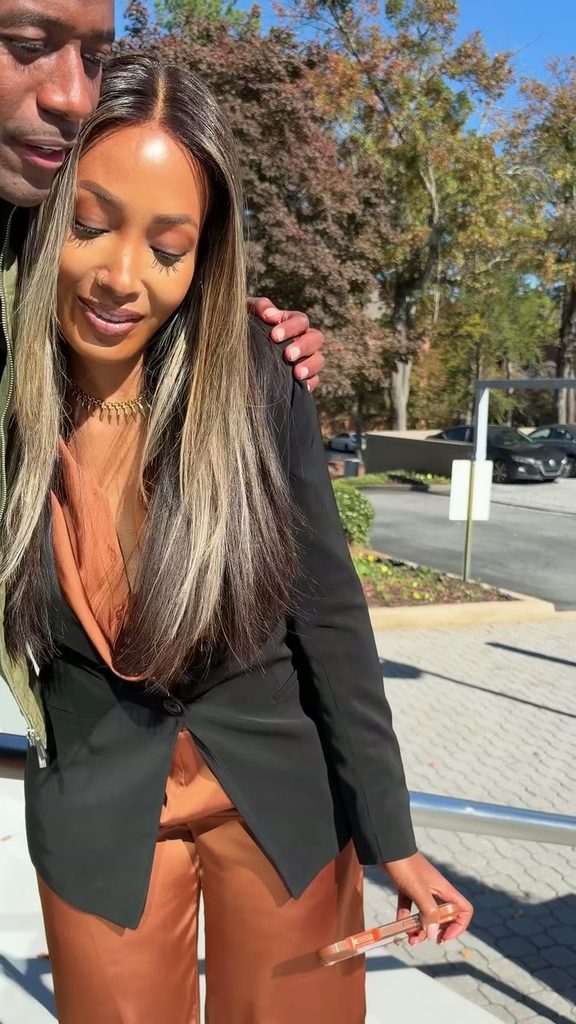
Openings in this saga are never accidents, and this one is a thesis statement filmed from a distance. The plaza is wide, sunlit, and public — a stage with no wings — and across it come two figures walking in step: Amber in her black blazer and rust satin, hair down, stride unhurried, and beside her the bearded man, keeping pace with the unstudied ease of someone who has walked beside her before. They are not rushing to the confrontation, and they are not sneaking up on it either. They cross the open ground the way parties cross a courthouse square: visibly, deliberately, at the speed of people who want the arrival itself entered into the record. Wayne is already there. Wayne can watch them come. The walk gives him time to understand what is approaching, and gives her the one thing her solo arrivals never had — a witness to her composure from the very first step. Consider what the walk announces to anyone fluent in this storyline’s grammar. A woman coming to beg, to plead, to make one more attempt at saving something, comes alone and comes quickly, before her courage cools. A woman coming to deliver a position comes accompanied and comes slowly, because the position does not depend on the other party’s mood. Amber’s whole presentation in these frames — the tailoring, the pace, the escort — belongs to the second category, and it marks the distance she has traveled through this saga more honestly than any monologue could. The wife who once sat on floors waiting to be told the truth now approaches the truth’s administrator like a delegation. There are two of them. The delegation has already decided what it thinks. The meeting is a courtesy. And the man beside her, in these opening frames, performs his entire role in miniature: he matches her pace, he takes the position at her shoulder rather than in front of her, and he lets her be the delegation’s face. Whatever he is — and we will come to the mystery honestly — he is not there to speak for her. He is there so that she will not have to be, ever again, the only person in the frame who is on her side. In a storyline where Amber’s isolation has been the husband’s greatest structural advantage, that is not a detail. That is a regime change, walking across a plaza in a black turtleneck.
THE ARM AROUND HER SHOULDER
The early close frames contain the video’s smallest gesture and its largest claim: his arm, resting around her shoulder as they stand together, and Amber beneath it — smiling faintly, eyes lowered for a moment, entirely at ease inside the contact. In a saga that has documented this woman’s loneliness with almost documentary persistence, a casual arm deserves to be read the way lawyers read signatures. It says: this person is claimed by somebody’s loyalty. It says: she did not have to assemble herself alone this morning. It says — to Wayne, who is watching, and who understands human signaling the way preachers understand weather — the era in which Amber could be managed as an isolated party, counseled separately, informed last, and counted on to absorb everything quietly, is over. She has people now. The people have shoulders. The shoulders are here. It is worth pausing on how Amber receives the gesture, because her ease inside it is the footage’s most efficient character development. This is not a woman being rescued — nothing in her posture asks for rescue, and within minutes she will be conducting the confrontation entirely herself. The arm is not carrying her. It is credentialing her: the physical equivalent of a party arriving at a negotiation with counsel present, not because she cannot speak, but because the other side must understand that her words now have a record, a witness, and a constituency. Divorce proceedings teach this lesson to anyone who watches them long enough — the spouse who shows up supported negotiates a different settlement than the spouse who shows up alone, not because the law changes, but because the room does. Amber has changed the room. She changed it before the first word, with an arm and a walk and a man who says nothing. And for the saga’s longer memory: place this frame beside the ones that defined her earlier chapters — the woman on the floor with her head in a borrowed lap, the woman alone in a lawyer’s office blinking at the word alimony, the woman discovering, room by room, that her marriage had a second set of books. The through-line of those images is a person being informed. The through-line of this one is a person arriving informed, accompanied, and visibly backed. Stories in this saga are supposed to be about who did what to whom. Sometimes they are about simpler revolutions: a woman who used to enter the frame alone, entering it — like never before — with somebody’s arm around her shoulder.
THE SILENT MAN’S WHOLE PERFORMANCE
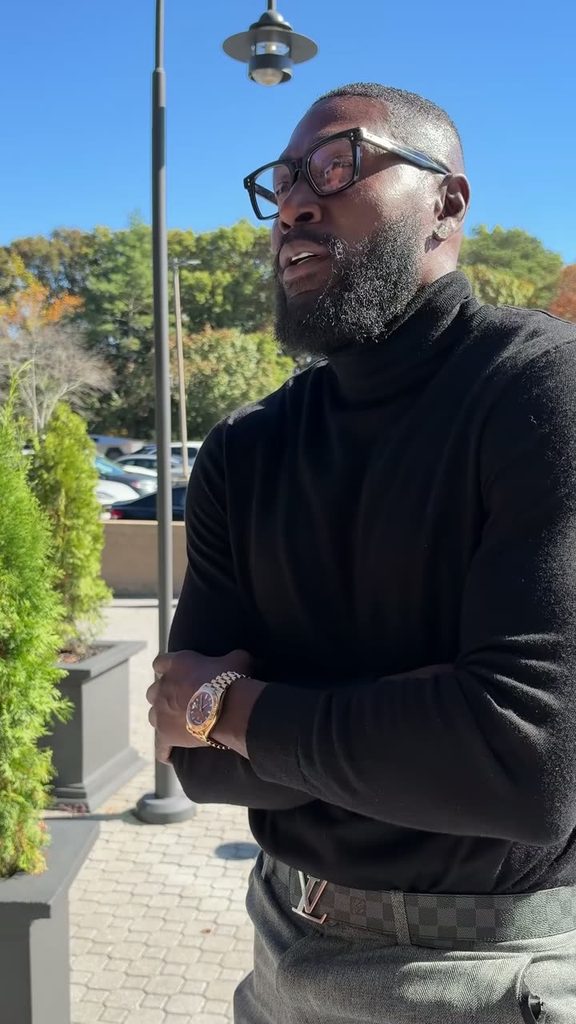
Then the confrontation begins, and the silent man performs the most disciplined role in the video: he does nothing, at length, on camera, with total commitment. The frames find him stationed in the background and at the edges — black turtleneck, glasses, arms crossed over his chest — while Amber conducts her argument and Wayne conducts his defense. He does not interject. He does not posture. He does not perform the protective-boyfriend theatrics that a lesser storyline would have written for him, no stepping between, no chest out, no words for Wayne at all. He simply witnesses, and the witnessing is the performance, because a confrontation with a witness is a different legal and moral object from a confrontation without one. Everything said in that parking lot exists now in a second memory. Wayne’s version of the afternoon — and Wayne has always been the saga’s licensed summarizer of afternoons — will never again be the only version in circulation. Any attorney will tell you why parties bring quiet people to loud meetings. The witness is not there to win the argument; the witness is there to make the argument real — to convert it from a story one side tells into an event both sides must account for. Amber, who has spent this saga discovering how thoroughly events can be re-narrated by the people who administer them, has plainly learned the lesson at the deepest level: she brought her own administrator. And the specific quality of his silence matters. An aggressive companion would have made the scene about himself and given Wayne the gift of a distraction. A fidgeting one would have undermined her. This man’s stillness — arms folded, face neutral, attention fixed — is the stillness of a person who understands that his job is gravity. He makes her position heavier simply by standing inside it. There is a moment-type, recurring across the footage, that captures his whole function in a single composition: Amber mid-argument in the foreground, Wayne mid-explanation opposite her — and behind the exchange, unmoving, the witness. The triangle is the story. Two people talk; one person remembers. In the economy of a divorce — where timelines get reconstructed, where he-said-she-said is the native language, where the spouse who was managed in private spends fortunes proving the private ever happened — a man who stood in a parking lot and watched the wife say it all to the elder’s face is not a bystander. He is an archive with a beard. And archives, as Wayne of all people should know, are forever.
WHAT HIS SILENCE DID TO WAYNE
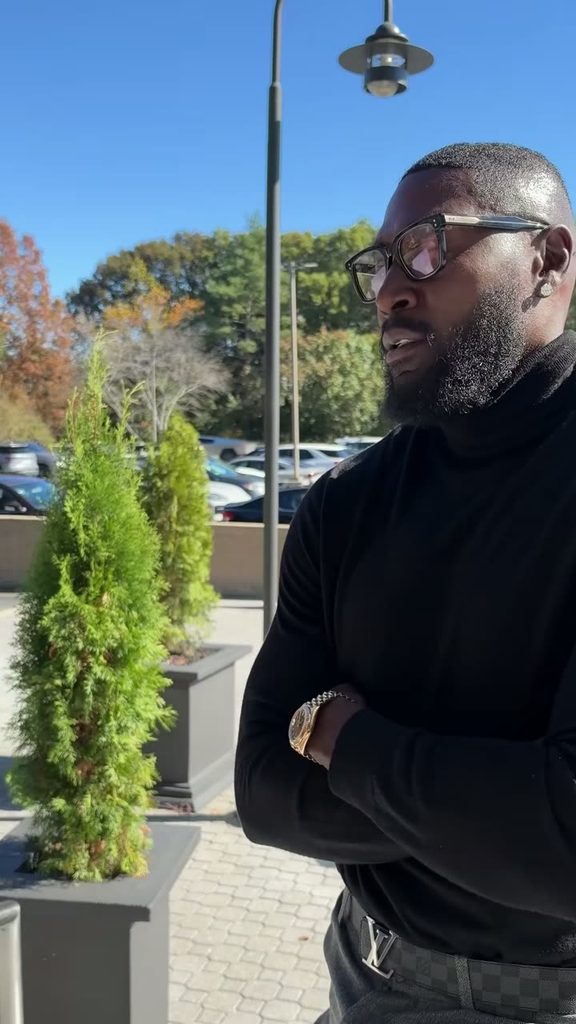
Wayne has faced down nearly every configuration this saga can assemble — furious husbands, collapsing wives, women arriving with revelations, men arriving with confessions — and his gift has always been the same: he reads the room faster than the room reads itself, and adjusts. The silent man breaks the gift, not by opposing Wayne, but by being unreadable in the specific way Wayne cannot process: he is an audience that cannot be preached to. Watch Wayne’s performance with this in mind and its strange doubleness comes into focus. He is defending himself to Amber, yes — but he is also, continuously, performing for the witness: calibrating for the second memory, aware that his explanations are being deposited somewhere he cannot later edit. The open hands, the reasonableness, the refusal to raise his voice even when the argument presses close — some of that is Wayne’s nature, and some of it is a man who knows the afternoon has a court reporter. This is, when you think about it, the first time Wayne has ever operated under the conditions he has imposed on everyone else. His whole office runs on being witnessed by him: characters moderate themselves in his living room because Wayne’s memory is the record, Wayne’s summary is the verdict, Wayne’s sermon is the closing argument. In the parking lot, the machinery runs in reverse. He is the one moderating himself under observation. He is the one whose afternoon will be summarized by somebody else. And Amber — who understood this before she ever crossed the plaza, who chose the witness the way lawyers choose venues — stands at the center of the reversal, arguing her case in the first room of her entire storyline where the record does not belong to the management. If you want a single sentence for what changed in this saga when Amber went at Wayne like never before, it is not about her voice at all. It is that she brought the archive with her this time, and the archive wore a black turtleneck and never said a word. The deepest effect, though, may be the simplest: the witness made it impossible for the afternoon to end the way Wayne’s afternoons usually end, with the elder’s benediction dissolving the conflict into wisdom. Benedictions require a congregation, and this congregation of one declined to be dissolved — he stayed, arms crossed, while the argument ran its full course, and he was still there when Wayne finally turned away. Some scenes end when the talking stops. This one ended when the talking had been fully witnessed. There is a difference, and Wayne, of all people, can be trusted to feel it in his bones.
THE QUESTION THE VIDEO REFUSES TO ANSWER

Honesty now requires the paragraph this story has been postponing: the footage never tells us who he is. No name is spoken that we can claim, no introduction is made, no caption explains him — he arrives as Amber’s companion and departs as her companion, and everything between those two facts is interpretation. He could be family. He could be a friend of long standing, the kind whose loyalty predates the storyline. He could be professional support of some kind, or the first quiet evidence of a personal life Amber is building in the ruins of the public one. This story will not guess, because guessing about a real person’s role in a woman’s life, from four minutes of parking-lot footage, is exactly the sport that has made this saga’s women miserable — and because the mystery, read correctly, is not a gap in the story. It is the story’s most respectful feature. For once, a detail of Amber’s life belongs to Amber, unexplained, unadministered, and not yet narrated by Wayne or anyone else. What the footage does establish — establishes beyond argument — is function, and function is enough. Whoever he is, she chose to bring him. She chose the plaza, the hour, the blazer, and the witness, and she conducted herself throughout like a woman whose support system is no longer a rumor. In the ledger of her divorce — the real one, in the court, where settlements are signed — such things do not appear as line items. In the ledger that actually governs a life, they are the whole balance: a woman who used to face the machinery of her own marriage alone, facing it now with a person at her shoulder and a record at her back. The saga will eventually tell us his name, or it won’t. Either way, the headline survives him: Amber has stopped coming alone. Every room she enters from now on — courtrooms included — will have to price that in. And perhaps that is the fitting place to leave him: unnamed, unbothered, arms crossed in the sunlight, the most eloquent extra in the saga’s recent history. He came, he stood, he remembered. The wife talked for four minutes and the elder turned away at the end of them, and somewhere in the frame’s edge the whole time was the quiet proof that the talking was not a performance anymore. It was a proceeding. Proceedings have witnesses. Now hers do too.
THE DEBATE: TEAM AMBER CAME PREPARED VS TEAM A PLUS-ONE CHANGES NOTHING

Team Amber Came Prepared treats the silent man as the confrontation’s decisive fact. Their case: Amber’s entire storyline has been a study in isolation as a weapon used against her — informed last, comforted late, managed in private rooms by people who controlled the record — and this video is the first time she arrives with the two assets that end isolation: a witness and a constituency. They will tell you the arm around her shoulder did more damage to Wayne’s authority than any sentence she spoke, because it announced that her words now had somewhere to live besides his memory. Prepared is not a strong enough word, they’ll say. She came institutionalized — a party of two, with a record, in a blazer — and the elder’s whole operation was built for parties of one. Team A Plus-One Changes Nothing answers that the saga is swooning over set dressing. Their case: the man said nothing, did nothing, and altered no fact — Wayne still explained, Amber still argued, the afternoon still ended without a signature, a settlement, or a single answer that a court would recognize. A companion is not counsel, they’ll argue, a witness to a parking-lot argument witnesses a parking-lot argument, and the divorce will be decided, as divorces are, by lawyers and documents in rooms this video never enters. Amber’s transformation is real, they’ll concede — but it happened in her posture and her stamina, not in her escort. Crediting the quiet man, they’ll finish, repeats the saga’s oldest habit: assigning a woman’s strongest afternoon to the nearest male presence. The tiebreaker belongs to the footage’s own composition, which keeps insisting — frame after frame, the talking pair in front, the remembering man behind — that presence was part of the event whether it spoke or not. But the floor, as always, is yours. Team Amber Came Prepared, or Team A Plus-One Changes Nothing? Argue it out — and know that somewhere, if this saga has any justice left in it, the silent man is reading the comments with his arms crossed, saying nothing, exactly as planned.