Bi…Four Minutes in a Parking Lot: A Round-by-Round Verdict on the Day Amber Went at Wayne
Dramatized skit recap based on the Kountry Wayne skit “When Amber goes at Wayne like never before!” No dialogue below is presented as exact quotes from the video.
Some confrontations you can score as they happen. This one — four minutes, three people, one parking lot, and a title promising that Amber goes at Wayne like never before — refuses to sit still on the scorecard, because the lead changes hands without anyone raising their voice. She arrives with a witness and takes the opening. He answers with the elder’s whole repertoire and takes the middle stretches on craft. She closes the distance, takes the argument into the range where repertoires stop working, and then he does the thing nobody in this saga has ever made Wayne do on camera: he turns away with the matter unsettled. Judges in boxing have a term for afternoons like this — a fight that is easy to watch and miserable to score. So let’s score it properly: round by round, on the footage, with the parking lot as the ring and the truth as the only purse. The ground rules matter, so let them be stated. Nobody swings; nobody storms off mid-round; nobody cries. This is a contest of position — her case against his authority, her stamina against his repertoire, her witness against his record — fought at conversational range in broad daylight. And hanging over the whole card is the context no judge can unsee: a divorce in progress, a husband who is not present, a double life that both fighters know by heart and neither one lived. She is scoring points about her own marriage against the man who administered its secrets. He is defending an office, not an alibi. Ring the bell.
ROUND ONE: THE ARRIVAL — AMBER, CLEARLY

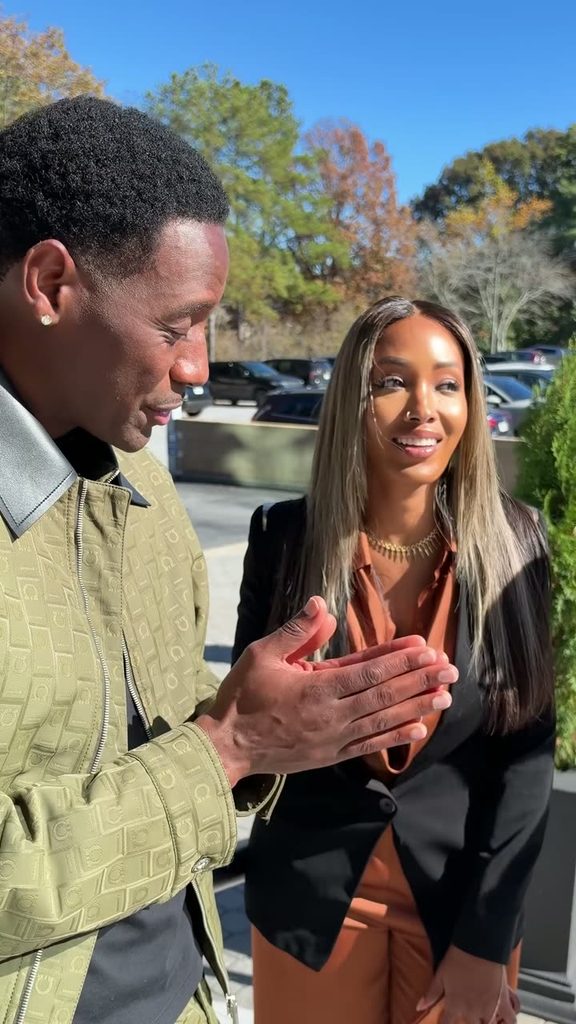
The first round is won before contact, on the walk-in, and it is not close. Amber crosses the plaza in a black blazer and rust satin with a bearded companion at her shoulder — his arm resting around her in the opening frames with an ease that tells its own story — and she takes the confrontation’s most valuable real estate without throwing a word: the terms. She chose the ground (public, sunlit, unstageable), the hour, the escort, and the wardrobe, and every one of those choices scores. Fighters call this ring generalship. Lawyers call it venue. Amber, who has spent this saga being summoned into other people’s rooms to receive other people’s versions of her own life, has finally convened a proceeding of her own — and Wayne, watching the delegation approach across open pavement, understands the paperwork instantly. His hands are open before she reaches him. Defenses that begin before the accusation are confessions of a kind, and the judges note it. Wayne’s corner will argue — correctly — that he does not give the round away cheaply. He stands his ground, receives her without bluster, and deploys the elder’s calm like a shield he has carried into a hundred rooms. But the scoring criteria are unkind to him here: effective aggression, zero; control of the ring, hers; the round’s only memorable images, her arrival and his open hands. There is also the witness problem, which will compound all afternoon: everything Wayne does from this point forward is being recorded in a memory he does not administer, and a fighter who knows the judges are hostile fights the judges instead of the opponent. Round one: Amber, 10–9, and the 9 is generous. File one more observation for the later rounds, because it decides the fight’s psychology: she is smiling in this stretch. Not broadly, not carelessly — the small, tilted smile of a woman who has already read the other side’s brief. Challengers who smile during the walk-in are either delusional or prepared, and nothing in Amber’s recent storyline — the lawyer’s office, the floors she has gotten up from, the education she has paid for in installments — suggests delusion. She came smiling because the speech was already written. Wayne’s whole career has been built on being the best-prepared person in any room. In round one, for the first time on camera, he is not.
ROUND TWO: THE CROSSED-ARMS OFFENSE — AMBER AGAIN, ON COMPOSURE
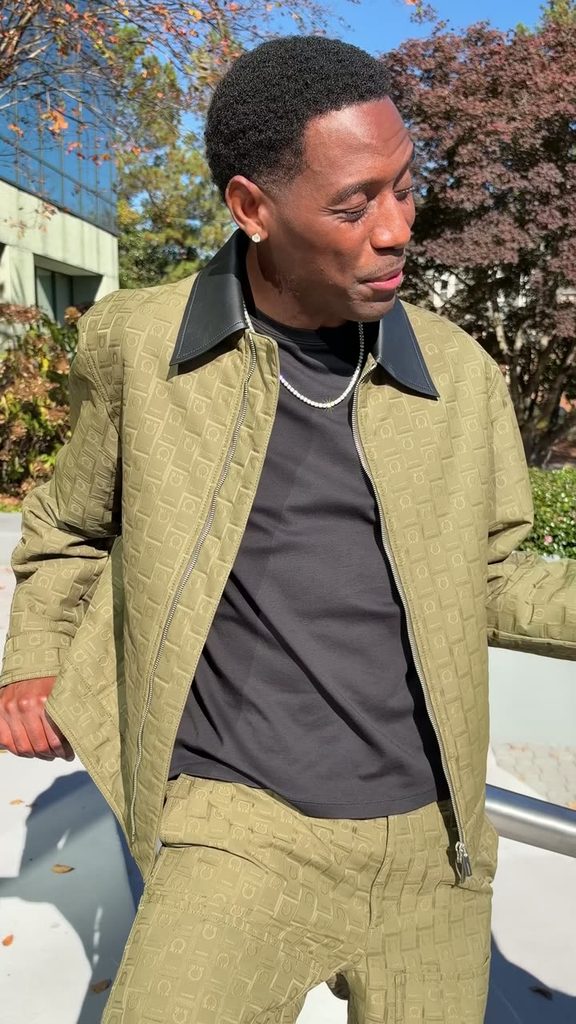
Round two is the fight’s strangest and most instructive, because Amber wins it by doing the least. The footage settles into its central rhythm: Wayne explaining — hands carving reasons out of the air, the preacher’s full vocabulary of reasonableness — and Amber receiving it with her arms crossed and that same evaluating calm, smiling at intervals like a cross-examiner recognizing testimony from an earlier deposition. In any ordinary argument, the talker wins the round. In a scored confrontation, the judges watch who is spending and who is banking — and Wayne is spending his entire arsenal against a defense made of posture. Every explanation he completes lands in the same place: her composure, which converts his best material into evidence that he has a great deal to explain. Her one visible adjustment in this round is also its most damaging image for his corner: the hands pressed briefly to her own chest, the universal who, me? of a woman hearing herself assigned a role in the story she has come to correct. It lasts a moment and scores like a knockdown, because it identifies, in pantomime, the exact nerve of her whole case — the wife, described back to herself by the management, in terms she no longer accepts. Then the hand rises to her chin and she goes thoughtful, and thoughtful is the most expensive expression Wayne has faced all afternoon: she is not rebutting him anymore. She is pricing him. Fighters lose rounds on the cards in exactly this way — outworked not by punches but by the dawning, visible realization that the other fighter has seen the whole fight already, in her head, in the car, and found his best material survivable. Score it 10–9 Amber, and note the pattern the card is establishing: through two rounds, the saga’s great explainer has landed nothing that changed her expression, while her silences have changed his tempo twice. But championship fights turn on adjustments, and Wayne has one more gear — the elder’s sincerity, deployed at close range — that he has not yet used. She is about to make him use it, by doing the one thing his whole defense is not built for. She is about to come forward.
ROUND THREE: WAYNE’S SERMON DEFENSE — THE ELDER’S BEST ROUND
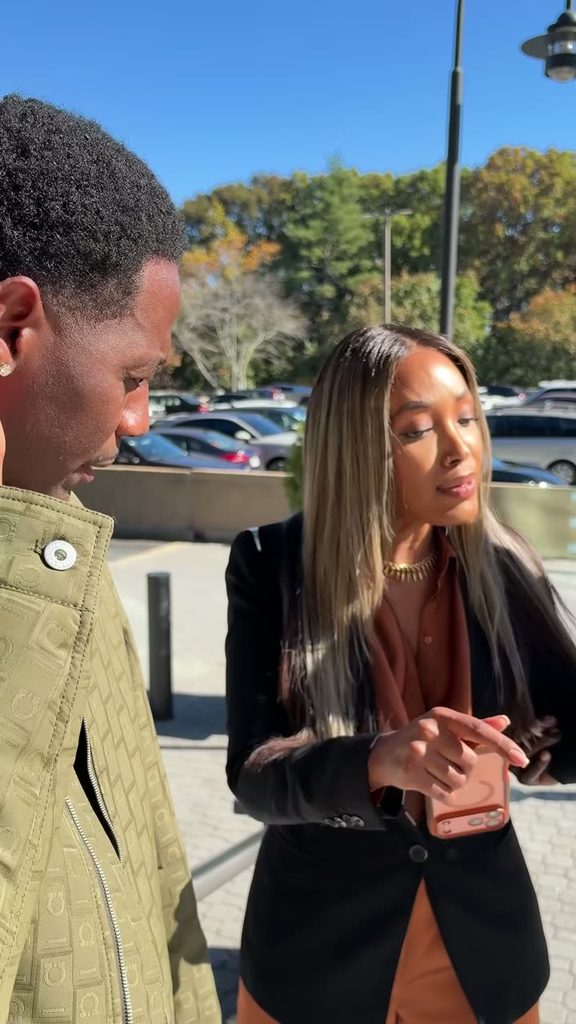
Credit where the footage demands it: round three belongs to Wayne, and it is the round that keeps this fight from being a coronation. Amber opens her offense — the long, animated stretch where she talks at full length, hands open, points arriving in combinations — and Wayne, instead of wilting under the volume, does what forty years of other people’s crises have trained him to do: he absorbs, he nods into the punches, and he answers with the elder’s sincerity at its most disarming. The gestures narrow. The palms turn up in appeal rather than explanation. He stops performing for the plaza and starts speaking to the woman — and for a stretch of footage, the confrontation’s temperature genuinely drops, because sincerity is the one pitch Amber’s prepared case was not written against. You cannot cross-examine a man’s remorse the way you cross-examine his excuses, and some part of her knows it; her combinations slow, just slightly, at the edges. His corner will also score, fairly, the round’s most underrated asset: he never once reaches for the cheap counters. He does not invoke his age, his office, his years of service to her family; he does not counterattack her character, her timing, or her escort; he does not do the thing the husband in this saga reliably does and perform shock at her tone. A defense conducted entirely without dirty tricks, in public, against an opponent with the crowd’s sympathy and a written speech, is a genuine achievement of craft — the kind divorce lawyers bill heavily to simulate. If the fight ended here, on craft, the elder would take it home on the cards and the saga would file the afternoon as another Wayne settlement: tense arrival, wise words, peace restored. But fights do not end on craft, and this one has a structural problem that round three exposes even as he wins it: his best material is all defensive. Every point he scores is a point for having absorbed hers. He is not advancing a case; he is surviving one, beautifully. And Amber — who has spent the round testing his sincerity the way buyers test a floorboard, pressing here, listening there — appears to reach, somewhere near its end, the conclusion her whole afternoon was built to reach: that his remorse and his explanations are both genuine, and both irrelevant, because neither one returns the years his silence administered. She gathers herself. The distance between them is about to close, and close-range is where sermons go to die. Round three: Wayne, 10–9 — his best round, and the last one the old rules will govern.
ROUND FOUR: THE CLOSE TWO-SHOT — WHEN IT GOT PERSONAL
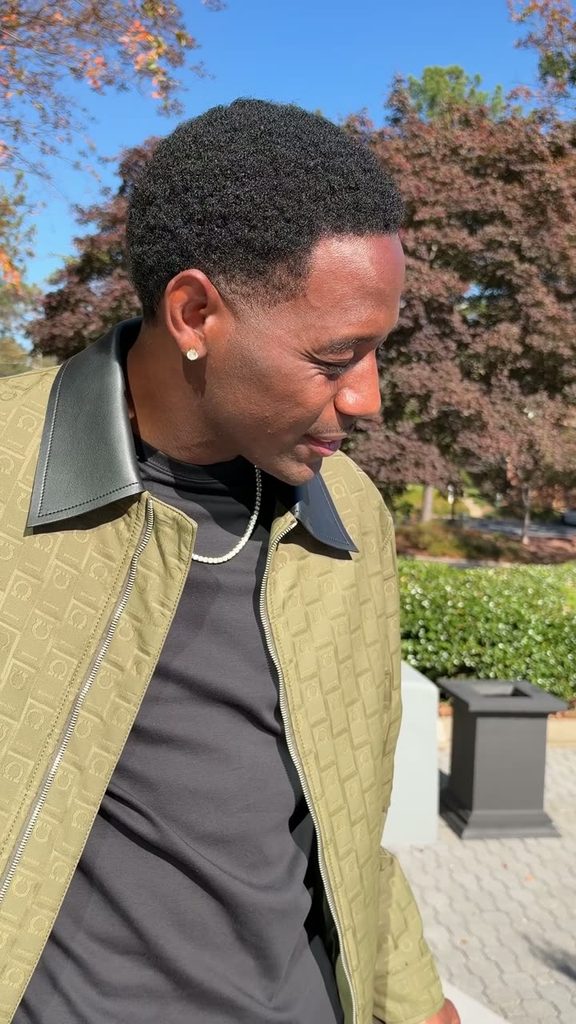
The final round is fought at the range where this saga’s confrontations either become history or become noise, and it becomes history. The camera finds them close now — Amber with her hands clasped before her, talking up into Wayne’s face with an intensity that has burned off every trace of the evaluating coolness of round two, and Wayne answering with his whole arm extended, appealing to the space, the witness, the afternoon itself. This is no longer a wife auditing an elder or an elder counseling a wife. This is two people who know exactly what the other one did, saying so at the distance where lying requires talent neither of them has left. Her clasped hands are the round’s signature image, and they deserve a slow reading: not crossed in defense, not open in appeal — clasped, like a woman holding her own case together with both hands, delivering its conclusion at the range of a confidence. Score the exchanges honestly, because the round is closer than her momentum suggests. Wayne’s extended-arm appeals land as what they are — the last tools of a man whose authority has always depended on the room agreeing to be a room, deployed now in a parking lot that has declined. Amber’s close-range combinations land as what they are too: the prepared case, arriving at its final counts, in the order she wrote them, without a single detour into the hysteria the storyline’s lazier narrators keep predicting for her. She does not scream. She does not unravel. She concludes. And a conclusion, delivered at close range by a composed woman in a blazer, is the hardest punch in this entire saga to answer — because it is not an attack at all. It is a finding. Findings are what judges issue. She has spent four rounds becoming the judge of the man who judged everyone, and in the close two-shot, the gavel is visibly in her hands. Then the fight does the thing that will argue in the comments forever: it ends without a bell. Wayne turns. The final frames hold him rotated away from her — profile to the camera, gaze back over the scene — while the matter between them stands precisely where she left it: stated, witnessed, unanswered in kind. Judges hate scoring retreats because retreats are ambiguous: a fighter can turn away in contempt, in mercy, in exhaustion, or in the simple recognition that the next word costs more than the last one bought. What is not ambiguous is the direction. In four minutes, the saga’s fixed point — the man everyone else turns toward — turned. The card is complete. The decision is a formality, and formalities, in this storyline, are where the fighting actually starts.
THE DECISION: A SPLIT CARD, AND WHAT IT SETTLES
The official scoring, for the record: Rounds one and two to Amber, on terms, composure, and the fight’s only clean images. Round three to Wayne, on craft and sincerity under fire. Round four to Amber, on the close-range conclusion and the turn it produced. A 3–1 card for the wife — with the asterisk that decides how history will file it: she won the fight she brought, in the venue she chose, against the opponent she selected, and the victory, like every victory in a divorce, is real and radically incomplete. No signature was obtained. No settlement moved, no court order issued, no alimony figure budged by a single dollar. The husband whose double life authored the entire afternoon was not even in the parking lot to be scored against — his custody calendar and his child support ledger will be settled by other people, in other rooms, on the divorce attorney’s clock. What Amber won is the thing she actually came for, which the record should state plainly because it is worth more than it sounds: she won the right to have her version be the version — stated at length, in daylight, before a witness, to the face of the man who had administered all the other versions. In a storyline built on managing a wife’s knowledge, the wife seizing the narration is not a preliminary result. It is the main event, and she took it on all three cards that matter. Wayne’s consolation, and it is not small, is that he lost the way institutions lose: slowly, decorously, and with the machinery intact. He will host again. He will counsel again. The switchboard will hum by the next crisis, because this family cannot route its emergencies anywhere else. But the exemption that defined his office — the confessor’s immunity from cross-examination — was revoked in that parking lot in front of a witness, and exemptions, once revoked in public, do not get quietly reinstated. Every character in this saga now knows the elder can be served. The wife has shown them the address, the hour, and the method: a blazer, a witness, and four minutes of never-before. Rematches in this storyline are not possibilities; they are scheduling questions. And the parking lot itself gets the last word, as venues do. It will go back to holding cars by evening, indifferent, sunlit, its painted lines already forgetting the geometry of the afternoon — her advance, his retreat, the witness standing witness at the edge of the frame. But the footage remains, and footage in this saga is the only court whose rulings nobody appeals. Somewhere in a lawyer’s office, a settlement is being drafted by people who will never see this video. Somewhere in the comments, the real jury is still deliberating. Which brings the decision, finally, to the only panel left unpersuaded either way: yours.
THE DEBATE: TEAM AMBER WON THE PARKING LOT VS TEAM WAYNE LET HER HAVE IT
Team Amber Won The Parking Lot reads the card the way this story scored it and rests: she took the terms, the composure rounds, the close-range conclusion, and the turn — four categories, one winner, and a title that turned out to be a spoiler. Their closing argument is about precedent: before this afternoon, no one in the saga had ever made Wayne defend himself at length, in public, without the protection of his own living room; after this afternoon, everyone knows it can be done, and the knowledge cannot be un-known. The wife did not just win a fight, they’ll say. She published the method. Every future confrontation in this storyline will be fought in the world she made in that parking lot — witnessed, on the record, and at the elder’s expense. Team Wayne Let Her Have It counters with the elder’s oldest defense: that the turn was not a retreat but a release — that Wayne, having absorbed the worst four minutes of her grief with his hands open and his voice down, chose to end the scene the way pastors end scenes, by declining to win against a woman whose husband he is still trying to save from himself. Their card reads round three as the fight’s true center: sincerity, offered at cost, received — whatever she says — somewhere under the blazer. And they will remind the judges that family court, where this saga is ultimately headed, does not score parking lots; it scores patterns, and a man who absorbs a wife’s worst afternoon without a single dirty move has built himself a pattern any lawyer would be proud to exhibit. A man who wanted to win that parking lot, they’ll argue, would have fought dirtier, louder, and with the whole archive open. He fought like a man protecting her dignity at the price of his own scorecard, and the turn at the end was not surrender. It was the benediction, delivered the only way she would accept it: silently, on his way out. The judges’ table, having scored it both ways all afternoon, will offer only this: a fight in which one side takes the rounds and the other side takes the meaning is a fight designed to be argued forever, and this saga — which monetizes forever — could not have scripted it better. Team Amber Won The Parking Lot, or Team Wayne Let Her Have It? Cast the deciding vote. The parking lot is empty now, but the record is open, and in this storyline the record is the only rematch that never gets cancelled.


