HA…No Affair, No Scandal, No Villain: An Autopsy of the Marriage Bethany Can’t Find Anymore
Dramatized skit recap based on the Kountry Wayne skit “Bethany cries to Larry and wonders what happened to their marriage” No dialogue below is presented as exact quotes from the video.
Every other marriage collapsing in this saga has a cause you can put in a headline. There is a husband with a second household, a baby with the wrong mother, a wife in a lawyer’s office learning the word alimony like a diagnosis. Causes, villains, exhibits — the full machinery of blame, ready for the divorce petition. And then there is this video: a woman in a green shirt, seated on her own back porch in the afternoon sun, crying to her husband and wondering what happened to their marriage — and the wondering is the whole event, because there is no headline. No affair has been produced. No secret has been detonated. Larry stands beside her chair with his hand on its frame, and the two of them confront the most common and least dramatized catastrophe in domestic life: a marriage that nobody murdered, dying anyway, of causes too ordinary to indict. This story is the autopsy the title requests. Cause of death: to be determined. Time of death: unknown — possibly years ago, possibly not yet. The body, inconveniently, is still warm, still seated, still asking questions. Autopsies of eroded marriages follow a protocol, and we will follow it here: examine the scene, interview the witnesses, reconstruct the timeline, and resist — as Bethany herself resists, through four minutes of footage — the temptation to invent a villain the evidence doesn’t support. Because the absence of a villain is not a gap in this story. It is the story. It is also, not incidentally, why this video may be the most quietly devastating four minutes the saga has produced all year: everybody watching it who has been married a long time recognizes the porch. The loud marriages belong to the characters. This quiet one belongs to the audience.
EXHIBIT A: THE SCENE — A PORCH, A CHAIR, A STANDING MAN
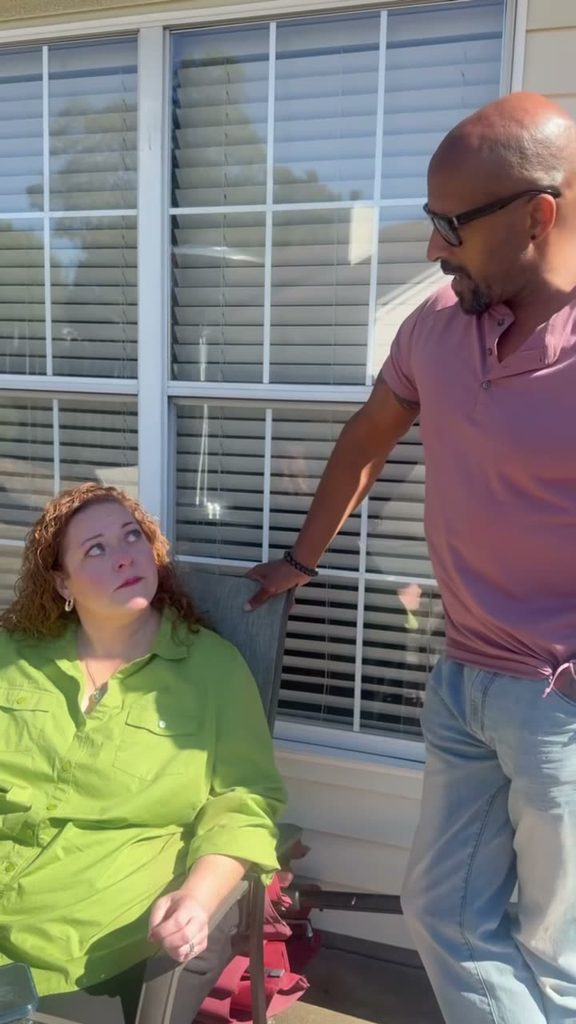
The autopsy begins where all of them begin, with the scene exactly as found. A back porch in full sun, wide windows with the blinds drawn against the afternoon. A patio chair, occupied by the wife, in a green shirt bright enough to read as defiance against the occasion. A husband, standing at the chair’s side, in a pink polo and sunglasses, one hand resting on the chair’s frame. A phone, present early in the wife’s hands and then forgotten, the way phones are forgotten when a conversation outgrows the digital world entirely. No raised voices are visible in the footage’s grammar. No objects are thrown, no doors are employed, no third party intrudes. Total elapsed event: under four minutes. Total damage visible: one marriage, condition unknown. Record what the scene does not contain, because in this saga the absences are forensic gold. There is no evidence bag because there is no evidence — no screenshots, no receipts, no discovered second phone, none of the documentary ordnance that Amber’s divorce runs on. There is no mediator either: no Wayne summoned to preside, no elder, no pastor, no marriage counselor’s office with its tissues and its meter running. And there is — this is the detail that should stop every viewer cold — no departure in progress. Nobody is packed. Nobody is leaving. The scene is not a marriage ending; it is a marriage being examined, in place, by its two inhabitants, like homeowners walking through a house after a slow leak, opening walls. Whatever has happened to Bethany and Larry has happened the way water damage happens: invisibly, structurally, over years, behind the paint. The porch conversation is simply the day they finally pressed on the wall and felt it give. Even the light testifies. This is not a midnight confession or a dawn confrontation — the traditional hours of marital catastrophe — but broad, ordinary afternoon, the hour of errands and lawn care, which is precisely when eroded marriages hold their audits in real life. The catastrophe did not schedule itself dramatically because the catastrophe is not dramatic. It is a Tuesday-afternoon kind of loss, and the footage’s sunshine is its cruelest special effect: everything looks fine. The house is handsome, the porch is pleasant, the couple is photogenic, the husband is attentive, the wife is composed — and the wife is asking, with her whole face, where the marriage went. Autopsies are supposed to begin with the exterior examination. Exterior: unremarkable. That is the finding. That is what makes it frightening.
THE WITNESSES: TWO PEOPLE, NO ACCUSATIONS
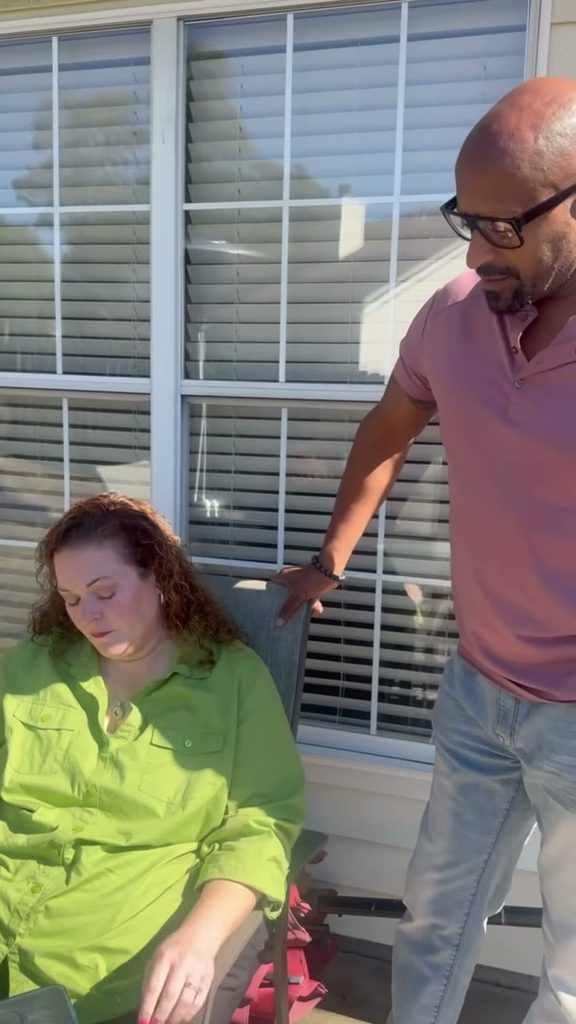
An autopsy interviews the witnesses, and this case has exactly two, whose testimony — as far as the footage lets us read it — is remarkable chiefly for what it never becomes. The wife testifies at length: the video is substantially her deposition, delivered from the chair in phases — level at first, then searching, then grieving, with her eyes closing at the hardest strata and her hand rising, palm open, at the moments where language runs out. What her testimony never does, in four minutes of visible emotion, is accuse. Her face prosecutes no one. She looks up at her husband the way a person looks at a locked room they once lived in — not demanding the key in anger, but grieving that the door, which used to open at a touch, now requires a conversation like this one just to knock on. If she believed there were a villain, her face would know where to aim. It aims everywhere and nowhere. It aims at the years. The husband’s testimony is physical, and the autopsy records it without translation: he stands beside the chair for the duration; his hand rests on its frame; he speaks in stretches, angled down toward her; he looks away, at intervals, toward the yard; he ends the proceeding by leaning down and holding his crying wife, whose hand spreads across his back like a signature. No counter-accusations are visible in his posture. No storm-off, no rebuttal-by-exit, no performance of wounded innocence — the standard defenses in this saga’s marital trials are entirely absent from his afternoon, and their absence is itself testimony of a kind. A man accused of a crime defends himself. A man confronted with a climate simply stands in it, getting wet, having no idea which cloud to address his rebuttal to. His stillness reads, on the autopsy’s table, as the stillness of a fellow mourner who arrived at the same funeral from the other door. Whatever happened to this marriage, the footage strongly suggests it happened to both of them — which is the precise definition of erosion, and precisely why neither of them can fix it by winning. The autopsy notes one more evidentiary absence, delicate but crucial: the children, the families, the entire supporting cast of this saga — none are invoked on camera. No one’s mother is on the porch. No elder has been summoned to translate. For four minutes, a marriage is examined exclusively by its two signatories, which almost never happens in this storyline and almost always happens in real life. The rest of the world will get its summary later, from one of them, edited. The porch got the unedited version. The unedited version, the record shows, consists of a question, a standing man, and a hug — and not one raised voice in either direction. Cause of death remains undetermined. The witnesses, it must be said, behaved like people who loved the deceased.
THE TIMELINE: HOW A MARRIAGE GOES MISSING WITHOUT LEAVING
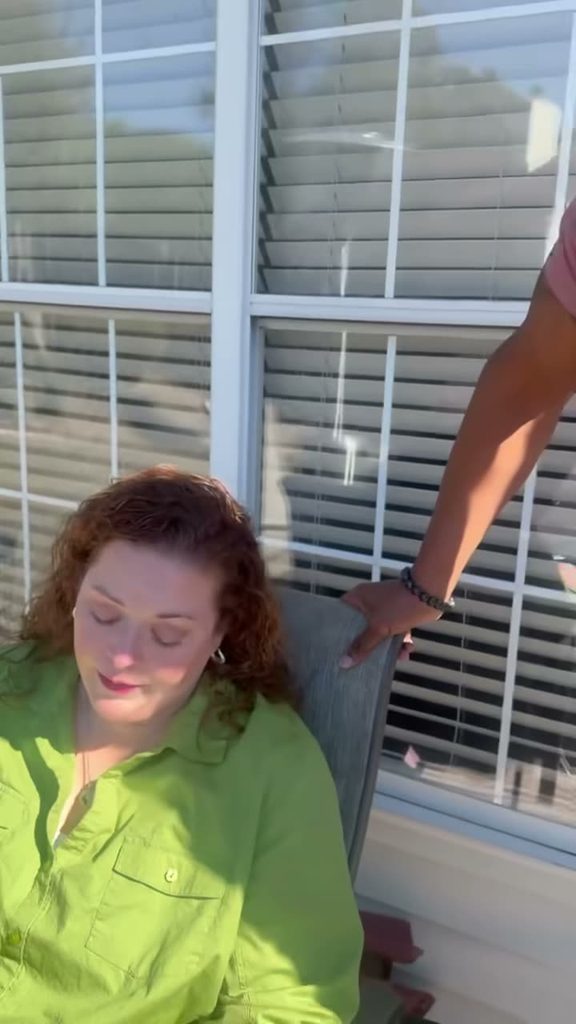
Reconstructing the timeline is the autopsy’s hardest section, because erosion has no timestamps — and Bethany’s wondering, which gives this video its title and its ache, is at bottom a timeline problem. She is not asking what he did. She is asking when it happened: when the marriage she remembers — the one that presumably had ease in it, and appetite, and the feeling of being chosen daily — was replaced by the current arrangement, in which a wife must schedule a porch summit to ask her husband whether he has noticed the replacement too. Every marriage counselor’s office contains this exact reconstruction attempt, conducted with calendars and photographs: the couple searching for the last good year the way investigators search a flight recorder for the last normal reading. The readings are always normal. That is the horror of the flight recorder in an erosion case. The plane did not malfunction. It simply, gradually, over thousands of unremarkable hours, stopped being flown. The strata, as wives in Bethany’s chair have described them in a thousand therapy offices, tend to run in a known order — and this story lays them out not as her facts, which we do not have, but as the standard geology her question is digging through. First, the layer where the marriage is the main event of both lives. Then the layer of construction — careers, house, obligations — where the marriage becomes the management company of a shared enterprise, competent and increasingly tired. Then the layer where the enterprise runs itself and the management stops meeting: conversations become logistics, affection becomes scheduling, and the couple becomes two professionals co-administering a life neither of them is quite living anymore. And finally the surface layer, the one with the porch in it, where one of the administrators — usually, as here, the wife — looks up from the paperwork one afternoon and realizes she cannot remember the last time the enterprise felt like a marriage. No affair required. No villain required. Just the paperwork, winning, year after year, in full compliance with everyone’s good intentions. The legal system, it should be noted, has no instruments for any of this. A divorce petition requires grounds, dates, a respondent — the law is built for explosions, and it processes erosions clumsily, converting them into paperwork about property and custody and settlement as if the assets were the injury. Bethany’s question cannot be filed anywhere. It can only be asked, on a porch, to the one other person who was present for the entire timeline — which is why, for all its quietness, this video documents the most honest legal proceeding in the saga’s recent history: a wife, serving her husband with the only document that describes their case accurately. A question mark, delivered in tears, in the sunshine, with her hand open. Received, the record shows, by a man who stayed to sign for it.
THE BODY IS STILL WARM: SIGNS OF LIFE, AND WHAT THEY COST
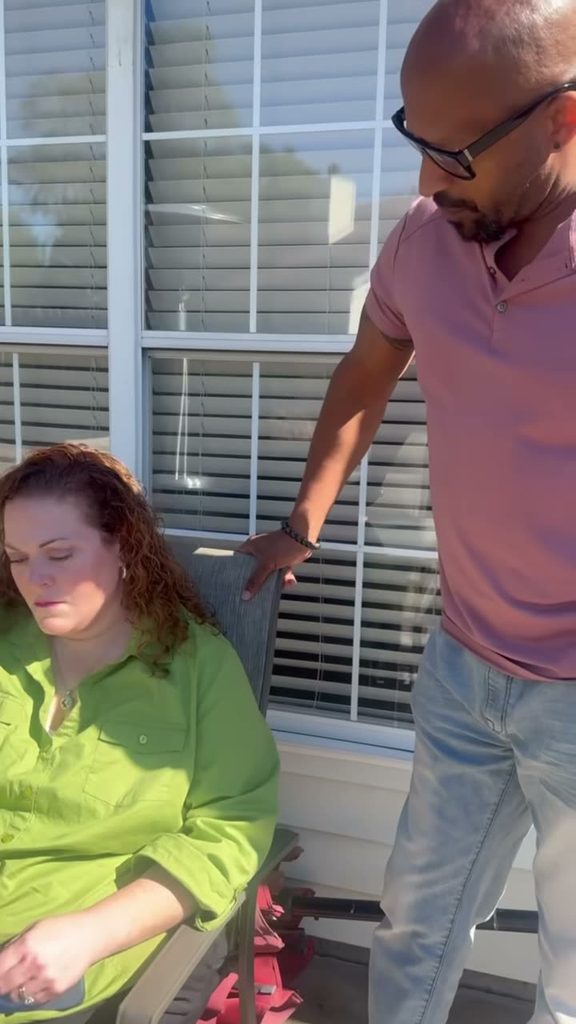
Every autopsy must answer the question the family is actually asking, so let it be asked here in plain language: is this marriage dead? The footage, examined without sentimentality, returns a genuinely divided report — and the division is the finding. In the column of the deceased: a wife who must ask, formally and in tears, what happened to her marriage has already established that the thing she is asking about is not in the room with her; you do not wonder where a living presence went. The distance is documented. The sunglasses are documented. The years of weather are documented in her face’s fluency — this grief has been rehearsed by solitude long before it was performed for an audience of one husband. By the evidence of her four minutes, something in this marriage ended a while ago, and the porch conversation is less a death than a notification: the surviving spouse informing the other surviving spouse. But the other column is not empty, and honesty requires its inventory too. A husband who stands beside the chair for the entire audit, hand on its frame, and closes the proceeding by holding his crying wife has not behaved as a man attending a formality. A wife who brings her question to him — to him, still, after everything the strata contain — rather than to a lawyer first, has not behaved as a woman who has finished hoping the answer might be survivable. The hug that ends the video is the autopsy’s most contested specimen: comfort, certainly; grief, visibly; but also contact — the infrastructure of touch, still load-bearing after all the weather. Marriage counselors build entire practices on thinner evidence than this hug. Divorce attorneys, who have seen a thousand couples, will tell you the ones who still hold each other mid-catastrophe are the ones whose files sometimes — not often, but sometimes — close without a signature. The body, the autopsy concludes, is still warm. The warmth is not a prognosis. It is, however, a fact, and on this porch facts have been in short supply for years. What the warmth costs is the final line of this section, because it is the part the well-meaning always skip: a warm body requires decisions that a cold one doesn’t. If the marriage were simply over, the afternoon could end in logistics — lawyers, settlements, the clean arithmetic of division. Because it is not simply over, the afternoon ends in the hardest homework two people can be assigned: the unfilmed, unglamorous, daily reconstruction of a thing neither of them can locate the blueprints for, possibly with a counselor’s help, possibly against a lawyer’s advice, certainly against the inertia of every habit that eroded it. The question Bethany asked has a follow-up, and the follow-up is the rest of their lives: now that we’ve said it — what, exactly, do we do on Tuesday? The footage ends before Tuesday. All autopsies end before Tuesday. The living have to go there themselves.
THE REPORT THE PORCH FILES
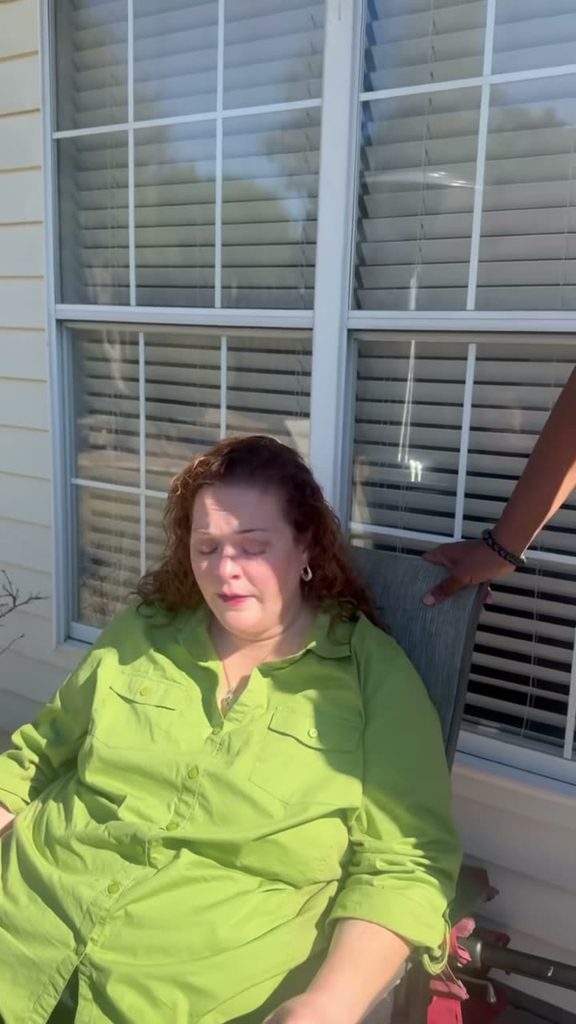
One more entry belongs in the autopsy, concerning what happens to its findings after the examiners leave the room — because a porch conversation, however honest, does not stay on the porch. It gets summarized. Within days, this marriage’s condition will exist in edited versions: the version Bethany gives her closest person, with the question at its center and the hug as its ambiguous footnote; the version Larry gives, if he gives one, in which the afternoon was emotional but fine, they’re fine, she’s fine; the version the family assembles from sightings and tone; and eventually, if the strata keep shifting, the version a professional receives — a marriage counselor hearing it as a presenting problem, or a divorce lawyer hearing it as a chronology, each translating the porch into their own paperwork. Every translation will lose something the footage kept: the hand on the chair, the closed eyes, the exact altitude of the hug. This is how marriages get misdiagnosed in the wild — not by lies, but by summaries, each one a little cleaner and a little less true than the afternoon itself. Which is why the video, for all the discomfort of its publicness, performs one genuine service for its two subjects: it is the unedited report, filed by sunlight, immune to revision. If Bethany and Larry ever sit in a counselor’s office disputing what the bad afternoon was like — she remembering a husband who barely participated, he remembering a wife who only cried — the porch will testify for both of them, and against both of them, with perfect neutrality. He stood the whole time: exhibit. She asked instead of accused: exhibit. The hug happened, and so did the sunglasses. Marriages rarely get evidence this fair. What they do with it — whether the report becomes a treatment plan or merely the best-documented chapter of a settlement — is the one finding no autopsy can file in advance. The porch has done its work. The paperwork, of one profession or the other, is next.
THE DEBATE: TEAM EROSION IS THE REAL KILLER VS TEAM SOMETHING MUST HAVE HAPPENED
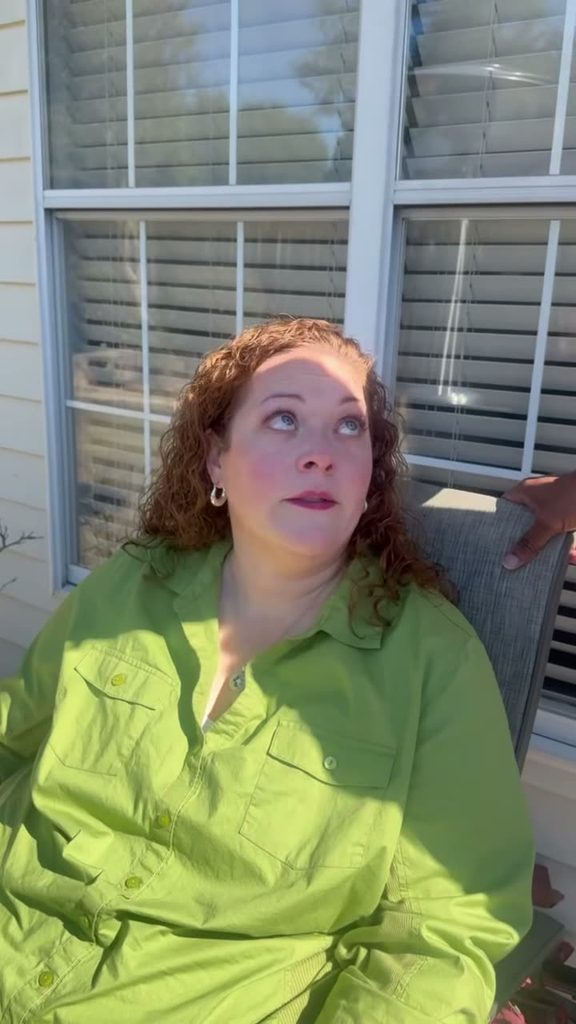
Team Erosion Is The Real Killer argues that this video is the most honest four minutes in the saga precisely because nothing happens in it. Their case: the loud divorces — the affairs, the babies, the lawyers — are the storyline’s entertainment, but erosion is marriage’s actual leading cause of death, claiming more real unions than every scandal combined, and it claims them exactly like this, in sunshine, between two decent people who cannot name a single crime. They will tell you Bethany’s question is the bravest sentence in the saga’s year because it indicts no one and therefore indicts the truth: that love is not killed by enemies but by inattention, that a marriage can be lost by two people who never once stopped being married. The porch, they’ll say, is every porch. The chair is every chair. The audience isn’t watching a character. It’s watching a mirror with better lighting. Team Something Must Have Happened answers with the skeptic’s oldest instinct: marriages do not erode in a vacuum, and a wife does not cry like that over weather. Their case: somewhere in the strata there is an event — a betrayal of confidence, a priority chosen wrong a hundred times in the same direction, a door closed one night that never reopened — and the footage’s gentleness is not innocence but editing, the version of the story a couple performs when both parties have agreed, without words, to keep the event off the porch. They will point at the sunglasses, at the standing, at the question’s very phrasing — what happened, not what is happening — and argue that even Bethany’s grammar confesses a before and an after, a border in the timeline where the marriage she mourns was still alive. Erosion is just the name we give a hundred small events we have agreed not to count, they’ll finish. Count them, and the autopsy gets its villain after all: a thousand tiny ones, wearing the couple’s own faces. The autopsy’s official conclusion declines both invitations, and files the cause the way the footage earned: undetermined, with signs of life, in a case where the two witnesses are also the two suspects and also — this is the part no form has a box for — the two people most hoping the patient survives. Bethany asked what happened to their marriage. The most truthful answer the evidence supports is the one the video itself gives: it happened slowly, it happened to both of them, and on one sunny afternoon, on a back porch, they finally stood — and sat — in the same frame and said so. Team Erosion Is The Real Killer, or Team Something Must Have Happened? The comment section is now in session. The porch, as always, has already heard both sides, and kept the sun shining on everybody equally.


