Bi…It Ended in a Hug and Nobody Can Agree What the Hug Means
Dramatized skit recap based on the Kountry Wayne skit “Bethany cries to Larry and wonders what happened to their marriage” No dialogue below is presented as exact quotes from the video.
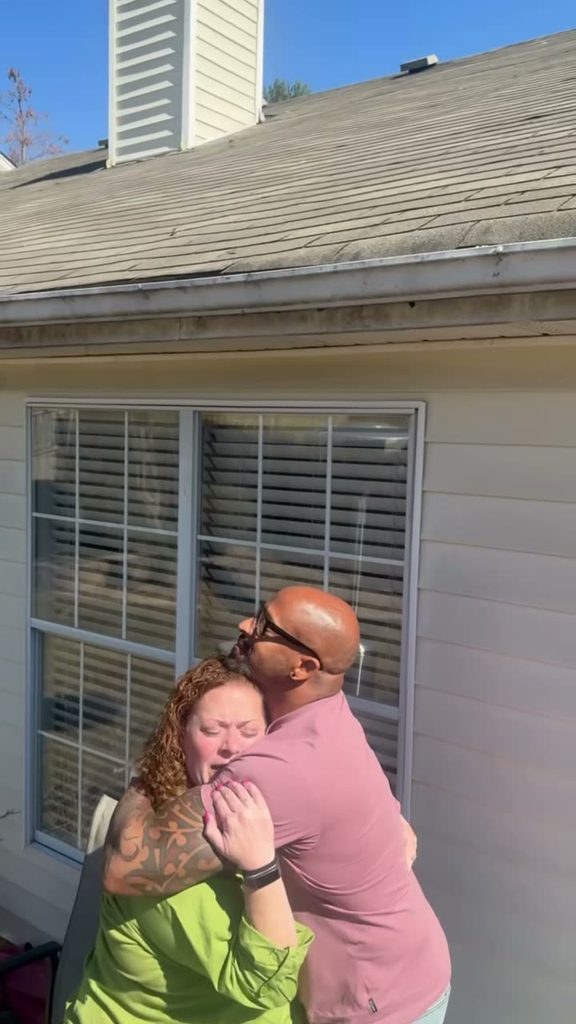
Every video in this saga gets remembered by its ending, and this one’s ending is a problem — a beautiful, insoluble problem that has had the comment section in session since it posted. Bethany cries to Larry on their back porch, wonders aloud for four minutes what happened to their marriage, and then the video closes with the two of them in an embrace: her face crumpled against him, her hand spread on his back, his arms around her, in full afternoon sun. No door. No driveway. No turned back. A hug. And because it is a hug — the most overdetermined gesture in domestic life — nobody can agree on what they just watched. Half the audience sees a reconciliation beginning. Half sees a goodbye being conducted at the speed of love. This story scores the whole afternoon by its phases, the way the footage presents them, and then rules on the only question that matters: what, exactly, did the last ten seconds decide? The ground rules are the same ones this series always uses: the footage is the evidence, the dialogue is unclaimed, and nobody’s interior gets invented. What the camera gives us is unusually complete — a full emotional arc in four movements, from a woman with a phone in her hands to a woman with her face against her husband’s chest, and a man who begins the video standing at a distance of furniture and ends it as the furniture’s replacement. Movement one: the question. Movement two: the digging. Movement three: the break. Movement four: the hug. Score them in order.
MOVEMENT ONE: THE QUESTION, ASKED AT LOW VOLUME
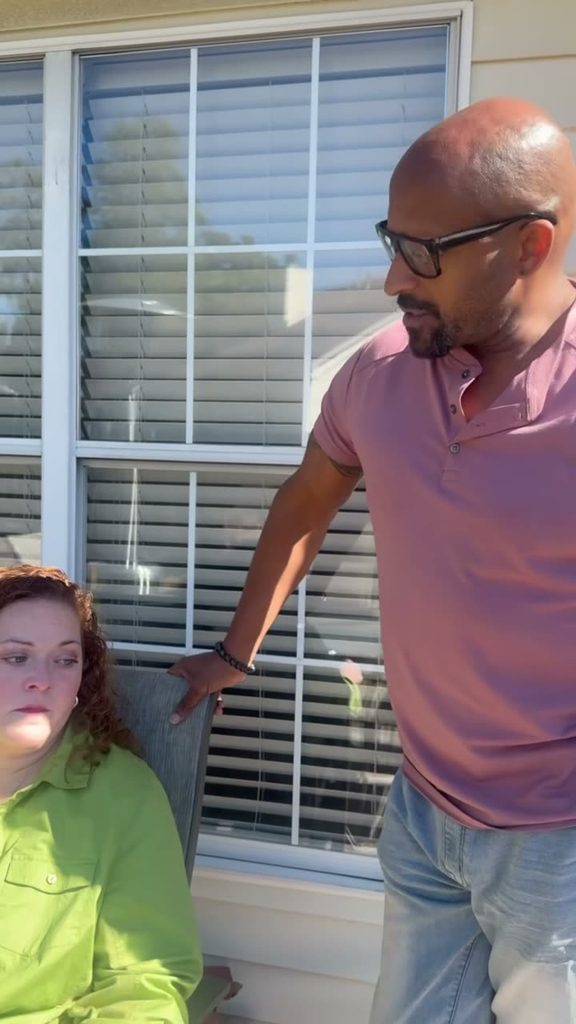
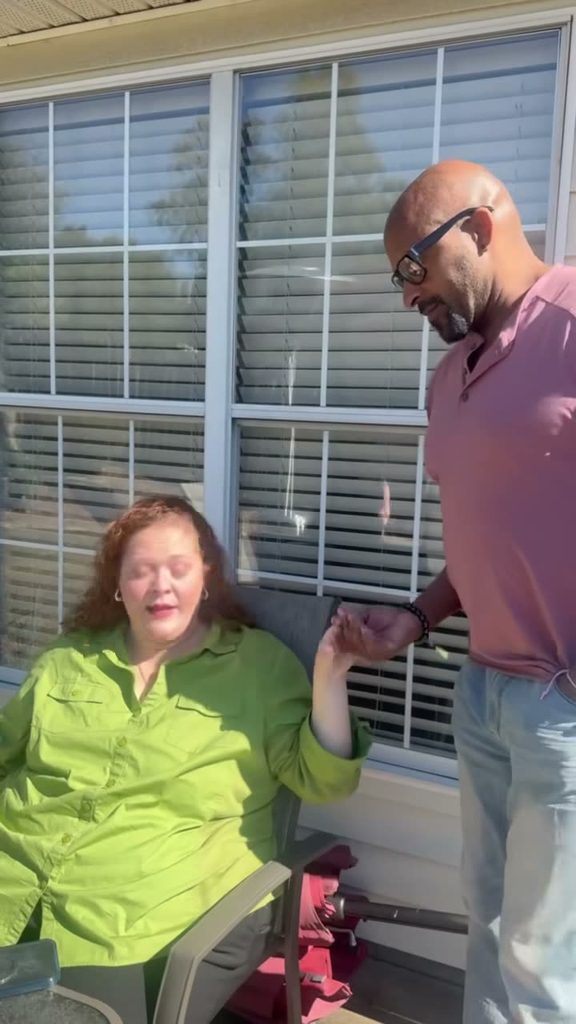
The opening phase of the video is the one casual viewers underestimate, because nothing in it is loud. Bethany is seated in the patio chair with her phone still in her hands — the posture of an ordinary afternoon, not an ambush — and Larry is already in position beside the chair, hand on its frame, when the conversation finds its subject. What the phase establishes, before any tears arrive, is the encounter’s strange civility: this is not a wife detonating a discovery, nor a husband being served with a scandal. It is two people who appear to have drifted, by mutual if unspoken consent, into the conversation both of them knew was living in the house with them. Her early expressions are searching rather than wounded — the upward glances, the level tone the posture implies — a woman still hoping, at this point, that the question might have a small answer. A schedule answer. A season answer. The kind of answer that ends with both of them laughing a little and the marriage reclassified as tired rather than missing. Score the husband’s opening too, because it sets his afternoon’s pattern: he receives the question standing, attentively, without a single visible gesture of the saga’s standard husbandly repertoire — no performed shock, no defensive windmill, no early bid for the exit. He is simply there, hand on the chair, in the sunshine, listening to his wife begin the audit of their entire shared life. In the scoring of long marriages, an opening like this earns quiet points from every judge who has ever sat through a couples therapy intake: both parties present, both parties vertical or seated by choice, nobody’s lawyer on speakerphone. The question has been asked in the lowest possible register. Everything that follows is the sound of its echo getting louder. And note what the low volume makes possible later: because the opening never becomes an attack, the ending never has to become a surrender. The hug, when it comes, will not be a treaty between combatants. It will be something rarer and harder to score — a gesture between two people who conducted the worst conversation of their marriage like adults and arrived at its final seconds still, recognizably, on the same side of the porch. Hold the thought. The digging is next, and the digging is where the afternoon stops being civil and starts being true.
MOVEMENT TWO: THE DIGGING — WHERE THE QUESTION GETS ITS WEIGHT
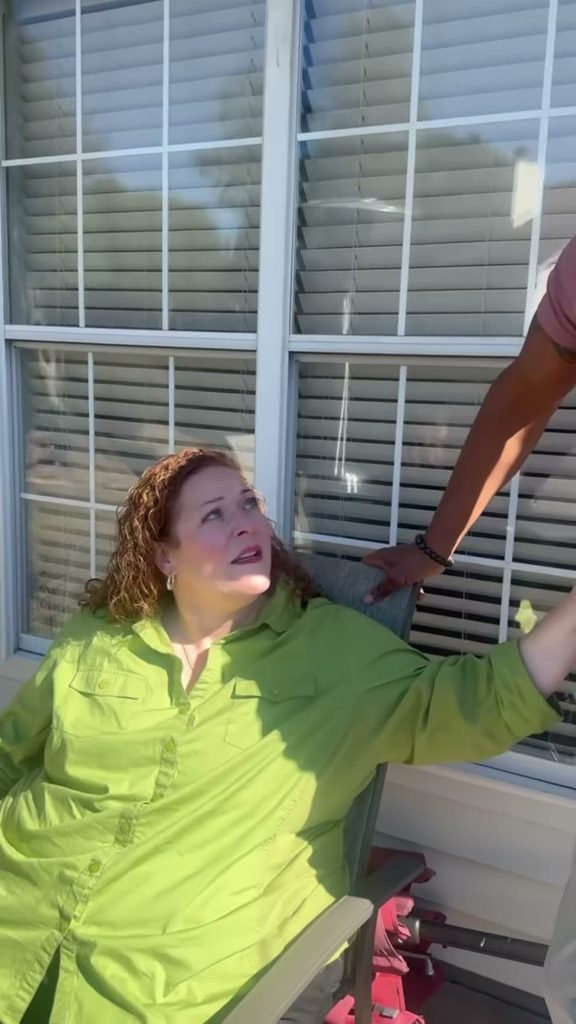
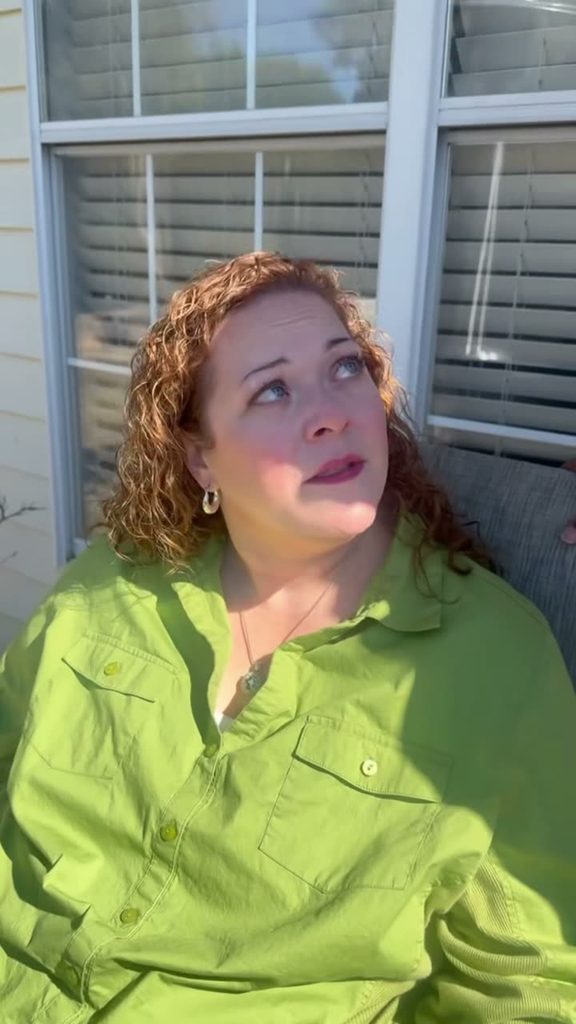
The middle of the video belongs to Bethany’s face, and the camera knows it, returning to her in close frame after close frame as the conversation descends through the strata. This is the phase where the question stops being a question and becomes an excavation: her eyes widening at her own sentences, her gaze dropping, her hand rising open-palmed when the words run smaller than the feeling, her hand pressing to her own middle when the feeling locates itself physically. What she is digging for — the footage’s grammar makes it unmistakable — is not a fact but a location: the place in the timeline where the marriage she is describing went from being her daily experience to being her memory. Husbands watching this phase tend to go quiet in a specific way, and Larry, in his stretches of frame, goes exactly that quiet: angled down toward her, jaw set, looking away at the yard at the moments when the near distance becomes too much to look at directly. Score this phase for her, clearly — it is the video’s center of gravity and she carries it alone — but score it honestly, noting what her dominance costs the eventual verdict. A conversation in which one party does all the excavating is a conversation whose findings belong to one party. Larry’s contributions in this phase are receptive: he stands, he stays, he answers in stretches the camera catches but the story cannot quote, and the asymmetry accumulates like interest. By the end of the digging, the record of the afternoon reads: the wife asked everything, the wife felt everything visibly, the wife carried the marriage’s entire emotional audit on her own face — while the husband’s face remained, behind its sunglasses, substantially classified. Judges in every field, from family court to couples therapy, are trained to notice who does the work in the room. In this room, on this porch, the work is hers, and the hug will have to answer for that asymmetry too: whether it was his first contribution to the labor, or his way of being excused from the rest of it. And yet the digging never turns prosecutorial — this is the phase’s saving grace and the video’s emotional signature. She digs like a woman searching a house she still lives in, not like an investigator building a case against its other occupant. The distinction will matter enormously in the debate, because it is the difference between a marriage being audited and a marriage being indicted — and only one of those proceedings ends, four minutes later, in an embrace. She wanted the marriage found. Watch her face in the last frames of this movement, eyes closing against the feeling at last, and you can see the precise moment the searching becomes grieving: the moment she stops expecting the digging to find it alive in the past tense, and starts needing to know whether it can be alive in the future one. The break is coming. It has been coming since the phone was in her hands.
MOVEMENT THREE: THE BREAK — AND THE MAN WHO DIDN’T MOVE
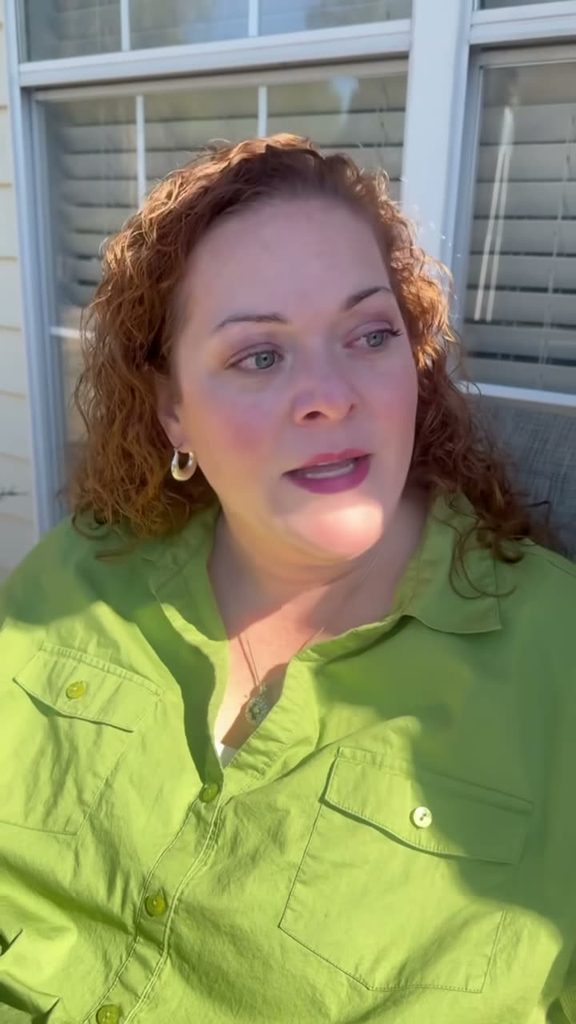
The break, when it arrives in the video’s final movement, is not theatrical. There is no single sob the camera builds toward, no collapse with a timestamp. It is a tide: her eyes closing for longer stretches, her chin dropping, her voice — by every visible sign — thinning out under the weight of the thing she has spent four minutes carrying uphill. Grief in long marriages rarely announces itself with an event; it arrives the way hers does, as the moment the person who has been holding the question finally runs out of the strength that holding it required. She has been composed, searching, articulate in posture for the whole audit. The break is simply the audit’s bill arriving. And the footage’s most important detail in this movement is not her tears. It is his location when they come: exactly where he has been all afternoon. Beside the chair. Hand distance. In the frame. This is where the scoring of Larry’s whole performance must be finalized, because movement three is the test his standing was either passing or failing all along. A husband can stand beside a chair for many reasons — duty, paralysis, pride, the hope that the conversation will end soon and standing will get him out of it faster. The break separates the reasons. When the tears come, the standing reveals its nature: he does not step back from them, does not fill them with advice, does not treat them as the conversation’s conclusion and begin his exit. The camera catches him in these frames angled toward her, the sunglasses finally irrelevant, a man whose entire afternoon of stillness resolves into its purpose — he was not standing over the conversation. He was standing by for this. Every marriage that survives its worst afternoon has a moment where one partner’s composure turns out to have been a form of readiness. The footage cannot prove that is what his was. It can only record that when the moment came, the readiness and the man were in the same place, at the same altitude, within reach — and that reach is about to become the ending. Score the movement to him, then — his first clean round of the afternoon — with the asterisk his critics have earned: it should not take a break to move him, and the marriage’s whole complaint, as his wife delivered it, is that it apparently does. The digging was hers. The breaking was hers. The moving, at the end, was his — and whether a marriage can be run on that division of labor is precisely the question the hug is about to pose and refuse, beautifully, to answer.
MOVEMENT FOUR: THE HUG — READ THREE WAYS
And so the ending, in its three defensible readings, because the footage supports all of them and chooses none. Reading one: the reconciliation. In this version, the hug is the answer the question was fishing for all afternoon — not a verbal answer, which neither of them apparently trusts anymore, but a physical one, older than the marriage’s problems and possibly more honest: we are still the people who hold each other when it breaks. She rises into him; his arms close; her hand spreads on his back with the fluency of long practice. Couples therapists have built entire methodologies on moments like this — the argument that ends in contact rather than distance is the argument a marriage survives, because the body’s vote, cast in the worst ten seconds, outranks every position paper the mouth delivered in the previous four minutes. In reading one, the video is the saga’s most hopeful marital document in months: a wife who asked, a husband who stayed, and an ending that shows the infrastructure still carrying weight. Reading two: the goodbye. In this version — darker, and supported by evidence its holders will cite precisely — the hug is what people do at the end of things they have loved: the embrace at the airport, at the hospital, at the lawyer’s office door. Her face inside it is not a relieved face; it is a grieving one, pressed into the chest of the man who is simultaneously her comfort and her loss, and his arms around her have the finality of a benediction — gentle, complete, and conclusive. In reading two, the question was answered all afternoon by everything except the hug: by the sunglasses, by the standing, by the years. The hug is simply the moment both of them stopped pretending the answer was different, and chose to hold the marriage once, carefully, at its conclusion, the way you hold anything you are about to set down forever. Divorce lawyers see this embrace in their lobbies. They do not mistake it for a reconciliation. They keep the tissues stocked for it. Reading three — the one this story files as the official verdict, because it is the only one the footage fully earns: the hug is a comma. Not a period, not a new chapter — a pause inside a sentence the marriage is still, somehow, in the middle of. It decides nothing about the strata, the distance, the question itself, which remains formally unanswered as the video ends. What it decides is the venue of everything that happens next: whatever Bethany and Larry do about their marriage — the counselor’s office, the long Tuesdays of attempted repair, or eventually, if it comes to that, the settlement table — they will do it as two people who ended their worst afternoon holding each other instead of holding doors. That is not a small inheritance from four minutes of footage. That is the difference between a marriage that died in anger and a marriage that is dying, or living, in sorrow — and sorrow, as every practitioner in the field will tell you, is the only one of the two that ever gets better. The hug is a comma. Commas are where sentences turn. The sentence, God and the footage willing, is not over.
THE TEN SECONDS, FRAME BY FRAME
Before the debate takes the hug away into argument, the record deserves one slow, forensic pass over the ten seconds themselves, because the details are doing more work than any interpretation. Her hand first: spread open on his back, fingers wide, gripping — not the polite pat of social embraces, not the loose drape of habit, but a hold, the kind a body takes when it has decided, below the level of thought, not to be set down yet. The tattoo on her arm is visible in the frame, the ordinary ink of an ordinary life, and somehow it testifies too: this is not a staged couple, this is a long life with a history written on skin, being held by the other person who knows what all of it means. His side of the composition: the head tilted back and away for a moment, the face turned up toward the light, in the posture of a man receiving something — weather, mercy, sentence — rather than delivering anything. His arms are not arranged for the camera. They are arranged around his wife. And the duration — the detail no still frame can give you and the video insists on. The hug does not clip. It holds through the footage’s final seconds without either party beginning the small negotiations of release: no loosening, no step back, no glance at the house or the yard or the next obligation. In the scoring of embraces — a discipline in which every marriage counselor and, for that matter, every divorce lawyer is an unwilling expert — duration is the datum that separates ceremony from contact. Ceremonial hugs end on schedule. This one ends because the video does. Whatever the two of them were saying inside it, they were in no hurry to stop saying it, and the porch, the sunlight, and the camera simply ran out before they did. Frame by frame, second by second, the ten seconds file their report: two people, one altitude at last, holding on past the end of the footage. Interpretations may now fight over it. The frames themselves have finished testifying, and they do not look like people practicing a goodbye. They look like people who forgot, briefly and completely, that anyone would ever ask them what it meant.
THE DEBATE: TEAM THE HUG MEANS HOPE VS TEAM A HUG CAN ALSO BE A GOODBYE
Team The Hug Means Hope presents the embrace as the afternoon’s only unambiguous data point and rests its case on the choreography: she rose into him — the seated woman, who had not stood for four minutes of audit, stood for the hug; he descended into her — the standing man, who had not sat for four minutes of audit, came down for the hug. Two people each surrendering their position’s entire geometry in the same ten seconds is not an accident of blocking, they’ll argue; it is the marriage’s two halves performing, in pantomime, the exact repair each had been withholding — she rising, he descending, meeting at an altitude neither of them had occupied all afternoon. Add the hand on his back, the full-duration hold, the absence of any subsequent exit, and the hope case closes with a flourish: goodbyes do not linger like that. Beginnings do. The couple that can still do this, they’ll say, has not finished anything except the pretending. Team A Hug Can Also Be A Goodbye answers with the lobby-of-the-law-office argument, and it is formidable: the most dangerous misreading in domestic life is the confusion of tenderness with trajectory. Their case itemizes the afternoon the hug is being asked to redeem — the question that had to be asked at all, the years inside it, the sunglasses, the standing, the wife who carried the entire excavation alone until she broke — and asks what, precisely, ten seconds of embrace repairs in that ledger. A hug costs nothing, requires no change, schedules no counselor, signs no new terms; it is the one marital gesture fully compatible with everything staying exactly as it was, which is why it is the favorite closing ceremony of marriages that end by winter. They will concede the hug was real. Reality was never the question. Funerals are real too, they’ll finish, and people hold each other at those for exactly as long, with exactly that grip on the back. The judges’ table, having scored all four movements, delivers the only verdict the footage supports: the hug is genuine, and genuineness is not a direction. It proves the marriage still has a pulse; it does not prove the pulse will be treated. What happens on the unfilmed Tuesday after this porch — whether the question gets a counselor, a plan, a changed altitude, or merely a fond memory of having once been asked beautifully — will retroactively decide what the hug meant, the way endings always rewrite their middles. Team The Hug Means Hope, or Team A Hug Can Also Be A Goodbye? The porch is quiet now, the sun has moved, and the two of them are still in the frame together — which is either the first fact of the reconciliation or the last fact of the marriage. Vote accordingly. They already have.