HA…Three Minutes on the Porch, Scored Like a Fight: Who Actually Won?
Dramatized skit recap based on the Kountry Wayne skit “When Shayla checks Anthony about bringing D’Nisha’s son to her house!” No dialogue below is presented as exact quotes from the video.
No punches, no shouting worth the name, no door slammed — and yet this video has the unmistakable structure of a prizefight, and the nearly one million people who watched it scored it the way crowds score fights: by rounds, by ring generalship, by who owned the ground when the bell rang. So let it be scored properly. The venue: Shayla’s front porch, her ground, her crowd of one camera. The champion of the venue: Shayla, in a long brown dress, defending the only title she has never lost — sovereignty of her own house. The challenger: Anthony, in a cream polo, fighting, as ever, in somebody else’s ring, over an offense the title states in plain language — he brought D’Nisha’s son to her house without her permission, and she came out of her front door to check him for it. Four rounds, one scorecard, and a decision the comment section will appeal forever. This is the fight, called clean. A word on the judging criteria before the bell, because porch fights are not scored like street fights. Points are awarded for control of the ground, for composure under fire, for the quality of a fighter’s best moments — and deducted, heavily, for fighting the wrong fight: answering charges that were never filed, defending territory that isn’t yours, spending energy the judges can’t score. By those criteria, this is a stranger and more interesting bout than the highlight frames suggest, because each fighter wins the rounds the other isn’t contesting. She wins the ground, the law, and the record. He wins the sincerity exchanges and the only moment of visible feeling that belongs entirely to him. The decision, when it comes, will turn on a question the saga never stops asking: in a fight about a house, does the house’s owner have to win the rounds — or does she win by the deed, before the first bell, with the rounds as mere ceremony? Score it yourself as we go. The judges’ card is at the end, and it is not unanimous.
ROUND ONE: THE ARRIVAL — AND THE DOOR CHANGES OWNERS

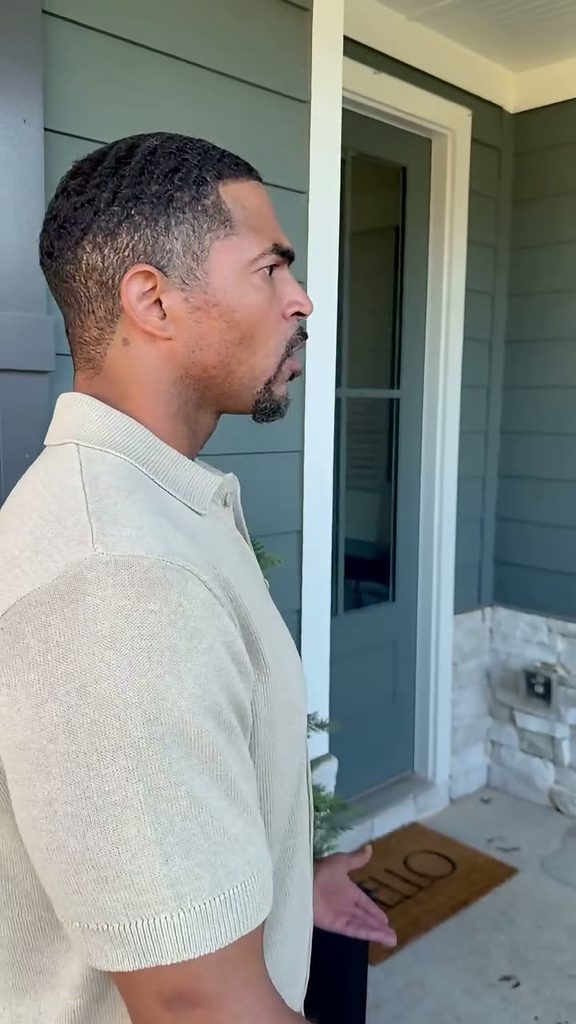
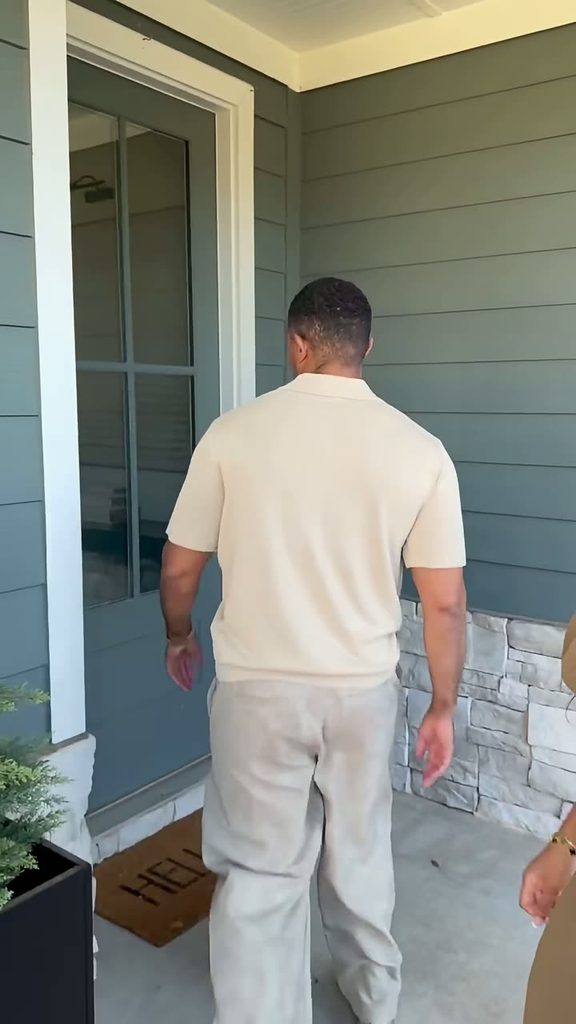
The fight’s first exchange happens before a word is scored, and it is the most important of the afternoon: Anthony comes out of the house first. Cream polo, light pants, unhurried, occupying the porch like a man preceding his guest into his own yard — the walk of a resident, a host, a man whose access is so settled it doesn’t occur to him to perform it. Ten seconds of footage, and the challenger has taken the round’s opening position by sheer presumption. Then the door opens again — and the round, the porch, and the video change owners. Shayla comes out of her own front door in the long brown dress, hair laid, posture at full height, and takes her ground the way champions take the center of the ring: completely, and without hurrying. The judges score the sequence as a tale of two entrances. His says: I belong here. Hers says: I decide who belongs here. Only one of those statements is backed by a deed, and the round — after a bright opening by the challenger — swings to the champion on the strength of a single fact the challenger cannot answer: she is the door’s owner, and she has just walked through it to say so. 10–9, Shayla. But mark the challenger’s confidence in your notes. Men who walk out of other people’s houses like owners do not expect to lose afternoons, and Anthony’s whole fight plan — such as it is — will be built on that expectation. The tale of the tape favors her everywhere except experience in this exact ring. She has the ground, the grievance, and the cleaner case: a visit, unpermitted, by a child whose presence in her house is a precedent in a custody war that family court never officially ends. He has the warmer story — a father figure, a boy, an innocent afternoon — and the harder task: he must convince the judges that the visit was a kindness, while standing on the property of the woman who was not consulted about it. Fighters have won from worse positions. They have rarely won from this one, on this ground, against this champion, with the deed in her corner. The bell for round two finds her already talking — and the talking, when it comes, is not what the challenger prepared for.
ROUND TWO: THE CHARGE — DELIVERED LIKE A VERDICT, NOT A SCREAM

The champion’s offense, when it opens, is a study in what the saga calls a check and what boxing would call fighting tall. Shayla does not rush the challenger, does not swarm, does not give him the brawl his defense is built for. She prosecutes at range, in posture: the extended hand, palm up — explain this; the chin set at parade rest; and her best weapon, deployed again and again through the round, the unimpressed face — lips closed, eyes level, the expression of a judge receiving a motion she is about to deny. Every exchange in the round follows the same geometry: he offers an explanation, the face receives it without flickering, and the explanation dies of its reception. Judges reward exactly this — clean, economical work that makes the opponent’s offense look expensive. Anthony’s explanations in round two are all expensive: full-body, full-volume, thrown wide. Hers are nearly free: a look, a tilt, a sentence. The round is not close. 10–9, Shayla, and the challenger’s corner — which is empty, because he fights all his fights alone — has nothing to tell him that he doesn’t already know: he is answering the wrong charge. She has not accused him of harming anyone. She has accused him of entering without permission. All his warmth, all his innocence-of-the-boy, all his fatherhood — scored by the judges under a category she never entered. He is winning an argument that is not on the card. It is worth pausing on the dress, because in this ring it functions as equipment. The long brown drape is the champion’s robe worn into the fight itself — composed, elegant, impossible to ruffle — and it does for her what great ring attire does for great fighters: it makes her look like the occasion and him look like the interruption. Against it, the cream polo reads as what it is: a man dressed for a comfortable afternoon who has found himself, to his visible surprise, in a title fight. Costume is not scoring, but presence is, and the presence differential in round two is the widest of the afternoon. The champion looks like the verdict. The challenger looks like the appeal.
ROUND THREE: THE PLEA — THE CHALLENGER’S BEST ROUND
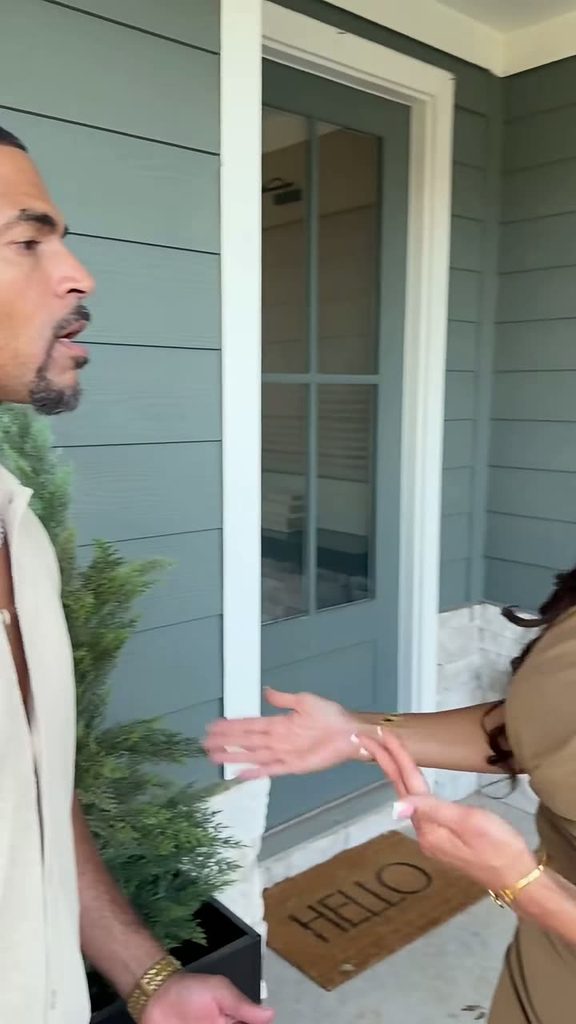
And then, because he is Anthony and because no fighter in this saga survives as long as he has without a real round in him, the challenger takes the third. The plea, when it comes, is his best work of the afternoon: the hands open wide — palms up, empty, the defendant’s oldest exhibit — and for the first time he stops explaining the visit and starts defending the man. The heated profile frames catch him at full sincerity, jaw set, voice presumably carrying the argument his whole career is built on: that his intentions are the fact of him, that a man should be judged by the place his acts come from, and that the place this act came from was love for a boy and a hope for a family less divided than the one the adults inherited. The judges score sincerity in this round because the champion, for once, lets it land — her face in these frames is not softer, exactly, but it is stiller, the stillness of a judge who has heard the one part of the defense that is actually testimony. He also lands the round’s single best point, and it is a point about her: that borders, enforced without exception, eventually guard an empty house — that a sovereignty never relaxed becomes a solitude with good paperwork. It is the only moment of the afternoon where her position, rather than her composure, is required to do work. 10–9, Anthony. The fight, entering its final round, is closer than the venue promised — two rounds to one for the champion, with the challenger, improbably, holding the momentum and the last word of the round still warm in the air. But score the cost, because the judges do. The plea took everything the challenger had: full body, full heart, the complete Anthony arsenal, spent to win one round on sincerity — a category the champion never contested, in a fight whose actual question (permission, precedent, the door) his best round never touched. Fighters call this winning the exchange and losing the geography. He leaves the third round having proven he meant well, in a fight that was never about what he meant. The champion leaves it having spent almost nothing, holding the ground, the law, and the deed, with her best material — the close — still unthrown. Championship rounds are where that economy tells. The bell rings for the fourth, and the porch goes quiet in the specific way of places where the ending is being decided.
ROUND FOUR: THE CLASPED HANDS, THE HAND ON THE CHEST — AND THE DECISION

The final round contains the fight’s two most honest moments, one from each corner, and they arrive almost together. Hers first: the champion’s hands, which have prosecuted all afternoon in gestures of audit and indictment, come together in front of her and clasp — fingers interlaced, held at her waist, in the posture of prayer or of holding something fragile. The judges have never seen it from her in this fight, and it changes the round’s temperature entirely, because it reveals what the check was guarding: not pride, not turf, but her own child’s place in his own home — the feeling she would never hand the challenger in words, confessed by the only part of her that wasn’t performing policy. It is the most human moment of the afternoon, and the judges score it as the champion’s deepest point of the fight: the moment the verdict showed its heart. His answer comes seconds later, and it is his own best truth: the right hand, rising to his own chest, spread over his heart — the oath, sworn when arguments are done. Whatever I did, it did not come from a bad place in here. The judges score it, too — sincerity, again, uncontested — and then they do the arithmetic the whole afternoon has been building toward. Sincerity was never the charge. The charge was the door. On the door, in four rounds, the challenger scored nothing at all. The decision, when the cards are read, is unanimous on the winner and divided on everything else: Shayla, by decision — the ground, the law, the composure, and the close all hers. But the cards carry an annotation the saga should not skip: the challenger leaves the ring with his dignity more intact than any visitor who has ever been checked on that porch, because he never ran, never shouted her down, never reached for the cheap weapons, and landed the afternoon’s only real blow — the question of what her borders are for, which will still be standing in her kitchen long after the porch is empty. No belt changes hands, because the belt was never his to take: it is a deed, and it stays where deeds stay. What changes is the toll. The door he walked out of like an owner will open for him again — this saga guarantees rematches the way it guarantees sunrises — but it will open by arrangement now, announced and permitted, in the boring currency he spent three minutes trying not to pay. The judges call that a decision for the champion and an education for the challenger. The crowd, as ever, calls it content, and is already demanding the rematch.
THE UNDERCARD: WHAT THE LAW WAS DOING WHILE THEY FOUGHT
Every main event has an undercard, and this one’s was fought, silently and simultaneously, in the record books of the only institution that scores these fights officially: the family court system that hovers over this saga like a ringside physician. While the champion and the challenger traded posture on the porch, a parallel bout was being scored in a different ledger — the custody ledger — and it is worth reading that card too, because it explains why a quiet conversation carries the voltage of a title fight. In the custody ledger, the afternoon’s events enter as follows: a non-custodial visit, conducted at the custodial home, without prior consent, involving a third party’s child, documented on video, by the father’s own storyline, in front of an audience of a million. Family court attorneys have a professional term for footage like that. They call it an exhibit. Every custody lawyer who has ever prepared a modification filing dreams of exhibits this clean: the date certain, the act undisputed, the respondent explaining himself at length and on the record, the custodial parent composed, precise, and visibly reasonable throughout. Shayla may never file anything. Anthony may never see a courtroom over this porch. But both of them fight — every fighter in this saga fights — under the shadow of the filing that could happen, and it disciplines their performances in ways the crowd never sees. It is why her check is a notification instead of a brawl. It is why his defense is an oath instead of a counterattack. They are not only arguing with each other. They are testifying, whether they know it or not, for a judge who isn’t there. Read the undercard’s scoring and the main event’s decision deepens. In the legal ledger, the visit’s innocence is nearly irrelevant; what scores is the consent column, and it is empty. Visitation rights, custody agreements, court orders about who may be brought into a child’s home and on what notice — the whole boring cathedral of family law exists to answer the exact question the porch argued about, and it answers it her way: by arrangement, in advance, or not at all. Child support can be calculated to the dollar and still leave a family at war; it is these unpriced courtesies — the knock, the notice, the ask — whose absence bankrupts households that are current on every payment. The judges at ringside scored the fight for the champion. The judges in the building downtown, had the afternoon ever reached them, would have scored it the same way, in a different vocabulary, with consequences measured in modified orders instead of applause. The porch knew. That is why the porch was so quiet, and why the quiet was so loud.
THE DEBATE: TEAM SHAYLA WON THE PORCH VS TEAM ANTHONY HELD HIS GROUND
Team Shayla Won The Porch reads the scorecard aloud: rounds one, two, and four, the ground throughout, the law unexamined and unexaminable, the custody agreement’s plain text and every family court lawyer’s instincts on her side. Their case is the deed and the discipline — she indicted the act and never the child, prosecuted in posture while he spent himself in explanations, and closed with the clasped hands that proved the check had a heart under its policy. A champion, they’ll say, is not the fighter who wins the loudest round; it is the fighter whose ground the fight happens on, whose rules the fight is scored by, and whose door both fighters walk through when it’s over. By every one of those measures, the porch was never in doubt — and the toll he pays from now on is the belt’s new inscription. Team Anthony Held His Ground answers that decisions can be correct and still miss the fight: that the challenger, outmatched on venue, law, and costume, still won the only round fought on human ground, landed the afternoon’s hardest question — what are the borders for, if they guard an emptying house? — and left with the champion’s own hands confessing that the check cost her something too. Held his ground, for this team, means exactly what the footage shows: he never left the porch, never lost his temper’s leash, never stopped arguing that a boy’s visit was a kindness, and absorbed a unanimous decision without once looking like a man who believed he had done wrong. Fighters who hold their ground in the champion’s ring, they’ll conclude, are the ones the rematch is invented for — and everyone in the comments knows the rematch is coming, because in this saga, it always is. The judges’ table files the official result and its footnote together: Shayla, by unanimous decision, on her own porch, under her own rules — and Anthony, by survival and sincerity, still standing in a storyline where standing is its own ranking. Team Shayla Won The Porch, or Team Anthony Held His Ground? Cast your vote below — the rematch, whenever Anthony next forgets to knock, will be scored the same way: round by round, hand by hand, door by door.