ATM Cash Withdrawal Tax Pakistan 2025 – New Rates, Limits & FBR Policy Explained

The Federal Board of Revenue (FBR) has announced major updates for the year 2025 regarding ATM cash withdrawals across Pakistan. The new policy revises tax rates, daily limits, and introduces real-time monitoring to encourage tax compliance and promote digital banking. Whether you’re a filer or a non-filer, these changes directly affect how much cash you can withdraw and how much tax you’ll pay.
What is ATM Cash Withdrawal Tax in Pakistan?
The ATM cash withdrawal tax, officially known as the “withholding tax on cash withdrawals,” is a small deduction that applies when you take out money from your bank account. This system was introduced by the FBR to discourage cash-based transactions and ensure transparency in Pakistan’s economy. By taxing cash withdrawals, the government aims to document financial activity, promote digital banking, and reduce dependence on physical cash.
Why This Tax Exists
Pakistan’s economy still operates largely on cash, making it difficult to track income and spending. To solve this, the FBR uses the ATM withdrawal tax to push more people toward digital systems and tax compliance. The goals are to encourage citizens to file income tax returns, track large cash movements, and reduce tax evasion. In short, this tax is designed to create a transparent and documented economy.
ATM Cash Withdrawal Tax Pakistan 2025 – What’s New
The Federal Budget 2025 introduced several important changes that all bank account holders should know. These updates mainly target non-filers but also include new rules for filers.
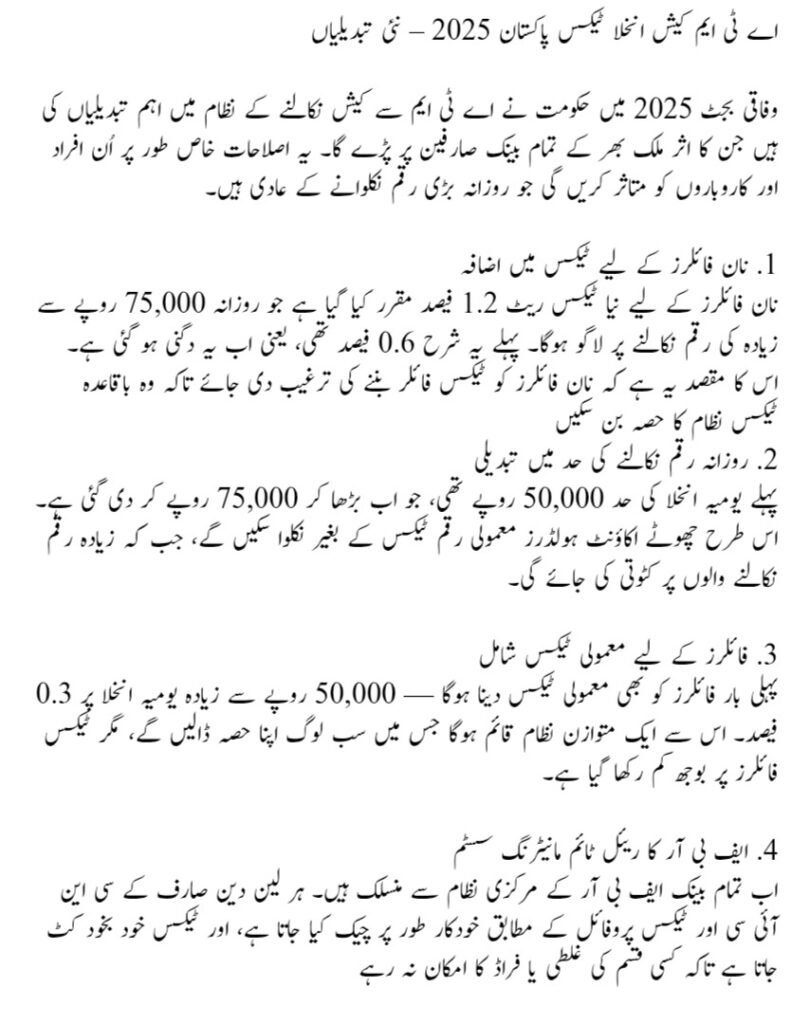
1. Higher Tax for Non-Filers
Non-filers now pay a 1.2% tax on total ATM withdrawals above Rs. 75,000 per day. Previously, the rate was 0.6%, meaning the cost has effectively doubled. This step aims to motivate non-filers to register as taxpayers since they now pay four times more tax than filers.
2. Revised Daily Withdrawal Limit
The previous daily limit of Rs. 50,000 has now increased to Rs. 75,000. This change allows small account holders to withdraw moderate amounts tax-free, while those exceeding the limit will face deductions.
3. Filers Now Included Too
For the first time, filers also pay a minimal tax rate of 0.3% on withdrawals above Rs. 50,000 per day. The goal is to create a fairer and more balanced system where everyone contributes a small share.
4. Real-Time FBR Monitoring
All banks are now connected to FBR’s centralized system. Each withdrawal is automatically verified using the customer’s CNIC and tax profile, ensuring accuracy and transparency.
ATM Tax Comparison Table
| Account Type | Amount Withdrawn | Tax Rate | Tax Deducted |
|---|---|---|---|
| Filer | Rs. 60,000 | 0.3% | Rs. 180 |
| Non-Filer | Rs. 100,000 | 1.2% | Rs. 1,200 |
| Small Withdrawal | Rs. 40,000 | 0% | No Tax |
| Insight: Non-filers lose up to 75% more money in taxes compared to filers — another reason why registering with FBR is financially smarter. |
Purpose of the 2025 ATM Tax Policy
The government’s aim goes beyond revenue collection. This new policy encourages tax filing, promotes digital transactions, and improves transparency in financial systems. It also supports Pakistan’s “Digital Pakistan Vision 2025,” which focuses on building a connected and cashless economy.
Impact on Filers and Non-Filers
For Filers: They pay only 0.3% tax on withdrawals above Rs. 50,000 per day and enjoy access to multiple digital payment methods without extra charges. Filers also qualify for FBR incentives and enjoy smoother banking services.
For Non-Filers: They face a 1.2% deduction on withdrawals above Rs. 75,000 per day and higher scrutiny from banks. They may also encounter issues when opening new accounts or conducting large transactions.
How to Check ATM Withdrawal Tax Deduction
You can easily verify your tax deductions through the following ways:
- Log in to your bank’s mobile app or online portal and check transaction details.
- Review your monthly e-statement where deductions appear under “Withholding Tax.”
- Visit the FBR IRIS portal (iris.fbr.gov.pk) to confirm recorded transactions.
- Some banks also send instant SMS updates about deducted amounts.
Real-Life Example
| User Type | Amount Withdrawn | Filer Status | Tax Rate | Tax Amount |
|---|---|---|---|---|
| Business Owner | Rs. 200,000 | Non-Filer | 1.2% | Rs. 2,400 |
| Salaried Employee | Rs. 100,000 | Filer | 0.3% | Rs. 300 |
| Student | Rs. 20,000 | Filer | 0% | No Tax |
| By registering as a filer, a person can reduce their annual ATM tax burden by up to 80%. |
Public Reaction and Expert Views
Many people have mixed opinions about the new tax policy. Some salaried employees believe they’re being double-taxed, while others see it as a necessary step toward economic reform. Economists, including experts at the Pakistan Institute of Development Economics (PIDE), argue that this tax helps expand the tax net since only a small fraction of Pakistan’s population currently files tax returns.
How to Reduce ATM Withdrawal Tax
- Become a Filer: File your income tax return to cut your rate from 1.2% to 0.3%.
- Use Digital Payments: Make payments through debit/credit cards or mobile apps, which are tax-free.
- Plan Withdrawals: Withdraw smaller amounts over multiple days to stay below taxable limits.
- Monitor Statements: Check your e-statements regularly for accuracy.
- Avoid Excessive Cash Use: Use digital wallets like Easypaisa, JazzCash, or NayaPay for daily transactions.
Impact on Pakistan’s Economy
The ATM cash withdrawal tax policy will help improve tax compliance, increase revenue, and reduce the country’s cash dependency. The Ministry of Finance expects this step to encourage digital payments and create a more transparent financial ecosystem that aligns with IMF and global standards.
FAQs
1. What is the current ATM cash withdrawal tax rate in Pakistan?
As of 2025, non-filers pay 1.2% on daily withdrawals above Rs. 75,000, while filers pay 0.3% on withdrawals above Rs. 50,000.
2. Is every ATM withdrawal taxed?
No. Withdrawals below the threshold are completely tax-free.
3. How can I check my deducted tax?
You can check through your bank statement, mobile app, or FBR’s IRIS portal.
4. Are digital transactions taxed too?
No. Online payments, card purchases, and bank transfers are exempt from this tax.
5. How can I become a filer?
Register at iris.fbr.gov.pk and submit your annual tax return to enjoy lower rates.
Conclusion
The ATM Cash Withdrawal Tax Pakistan 2025 represents a significant move toward a transparent and digital economy. While non-filers face a higher burden, filers benefit from reduced rates and smoother financial processes. By becoming a filer and shifting to digital banking, Pakistanis can save money and contribute to a stronger, more traceable economy.